Amazon does not buy your moodboard. It buys slot performance: a compliant main image, a gallery that answers doubts, and A+ stills that explain without breaking catalog rules. Teams that AI-generate “seven pretty heroes” still lose the Buy Box war on clarity.
AI Amazon listing images work when you treat the gallery as a system of jobs — not a folder of vibes.
Key Takeaways
>
– Main image = compliance + recognition. Secondary slots = doubt removal. A+ = story without replacing Truth.
– Listings with richer image sets convert more strongly in large studies (~50% higher with 5+ images vs thinner galleries in Catchlab-cited 2026 roundups).
– Reuse packshot angle families and scene jobs — mapped to Amazon slots.
– Upscale only after QA (upscale playbook).
Why Do Random AI Galleries Underperform on Amazon?
Because each thumbnail has a job in the purchase path.
| Slot | Job | Fail mode |
|---|---|---|
| Main | Recognize + comply | Props, text, lifestyle bleed |
| 2–3 | Form / angle truth | Duplicate beauty shots |
| 4–5 | Detail / texture / scale | Unreadable macros |
| 6–7 | Lifestyle / in-use | Fantasy that fights main |
| A+ | Features / compare / story | Walls of unread text |
If every file tries to be a campaign hero, none of them staff the gallery.
Amazon creative is information architecture with pixels. AI should fill slots, not audition for a perfume ad.
The Listing Image System
Layer A — Compliance Truth
- Main on approved background
- True color, full product, no promotional overlays (follow current marketplace policy)
- Geometry QA for hard goods
Layer B — Doubt Removers
- 45° / back / open-box / scale in hand
- Detail of materials and controls
Layer C — Desire / Context
- One honest lifestyle
- Keep dual-layer logic from visual commerce
Layer D — A+ Stills
- Feature callouts in clean layouts
- Comparison charts as designed graphics (prefer controlled text, not hopeful in-image AI type)
Playbook: One SKU, One System Day
- Write slot map — which file fills which job
- Shoot/generate Truth set reference-heavy
- QA geometry + typography
- Add one lifestyle only after Truth passes
- Build A+ frames from approved masters (crop + layout)
- Upscale delivery sizes once
- Contact-sheet review against competitor galleries in-category
Ratio/adapt habits from marketplace banners still help for off-Amazon ads — but on Amazon, slot jobs beat ratio panic.
Soft CTA
Produce listing-ready packshots and gallery systems: Ecommerce · Packshot
Frequently Asked Questions
Can AI generate Amazon main images?
Yes — if compliance and product fidelity pass. Treat main as the strictest Truth frame, not a creative playground.
How many lifestyle images should an Amazon gallery include?
Usually one or two. Fill remaining slots with doubt removers before stacking lifestyles.
Is A+ a place for experimental AI worlds?
Keep A+ clearer than experimental. Use approved product masters; add controlled graphics for features.
How is this different from TikTok Shop scene types?
TikTok optimizes scroll jobs (hook/demo). Amazon optimizes catalog jobs (compliance/doubt). Share masters; change the slot map.
Conclusion
Stop generating seven heroes. Staff seven jobs.
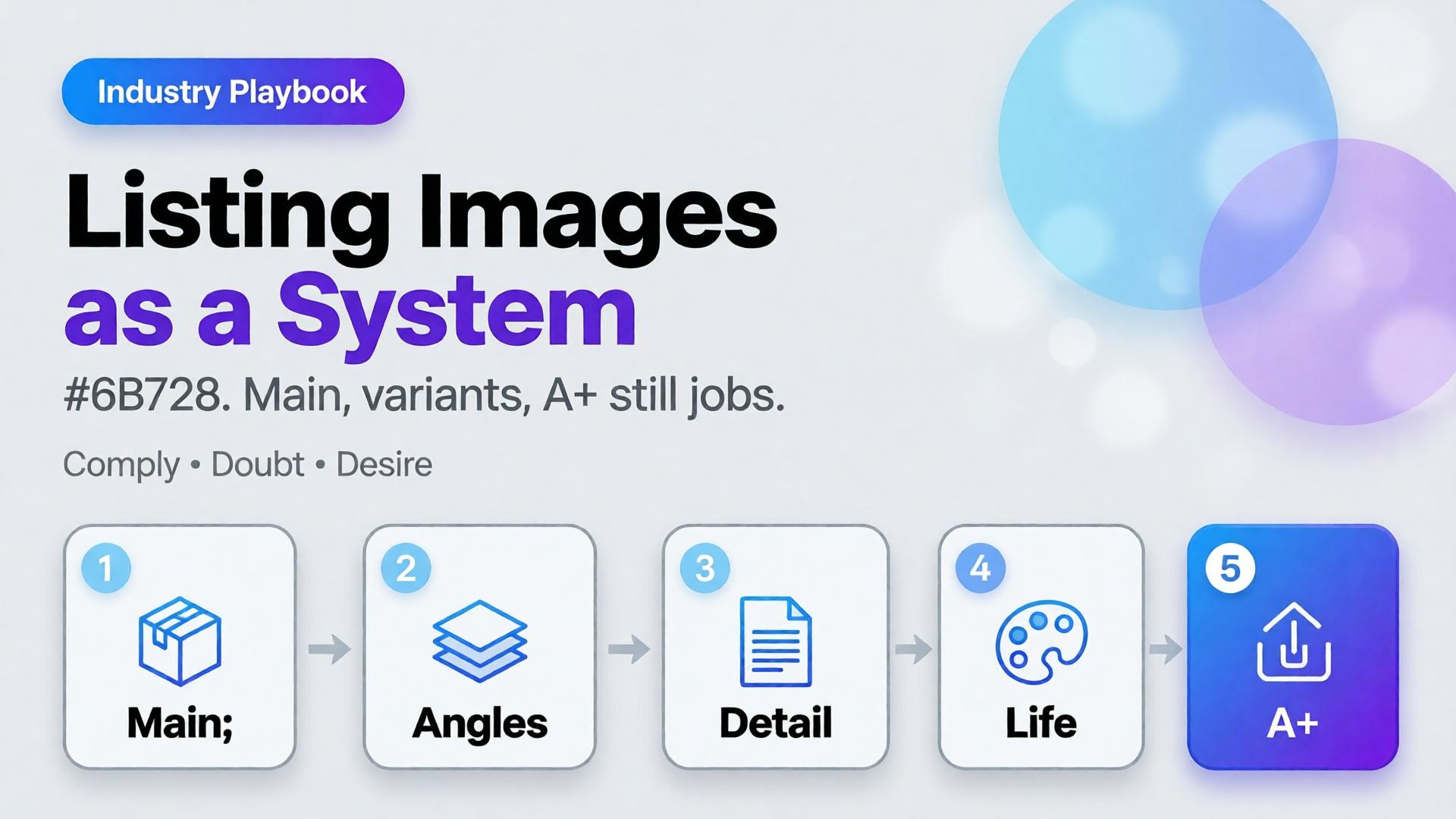
Main for compliance. Variants for truth. Lifestyle for desire. A+ for explanation. Gate fidelity. Then deliver.
That is an AI Amazon listing images system — built for the buy path, not the moodboard.
References
- Lumepixa, AI Product Photography Statistics 2026 (Catchlab / Salsify citations). https://lumepixa.app/blog/ai-product-photography-statistics
- Adobe, 2026 Creators’ Toolkit Report, June 16, 2026. https://news.adobe.com/news/2026/06/creators-toolkit-report-2026