TikTok Shop does not reward “pretty product on marble.” It rewards readable intent in the first second — then enough truth that a tap does not feel like a trap.
Most AI ecommerce batches fail here: every frame is a vague lifestyle. The hook looks like the demo. The demo looks like the offer. The offer looks like stock. Buyers scroll. You regenerate. Nothing compounds.
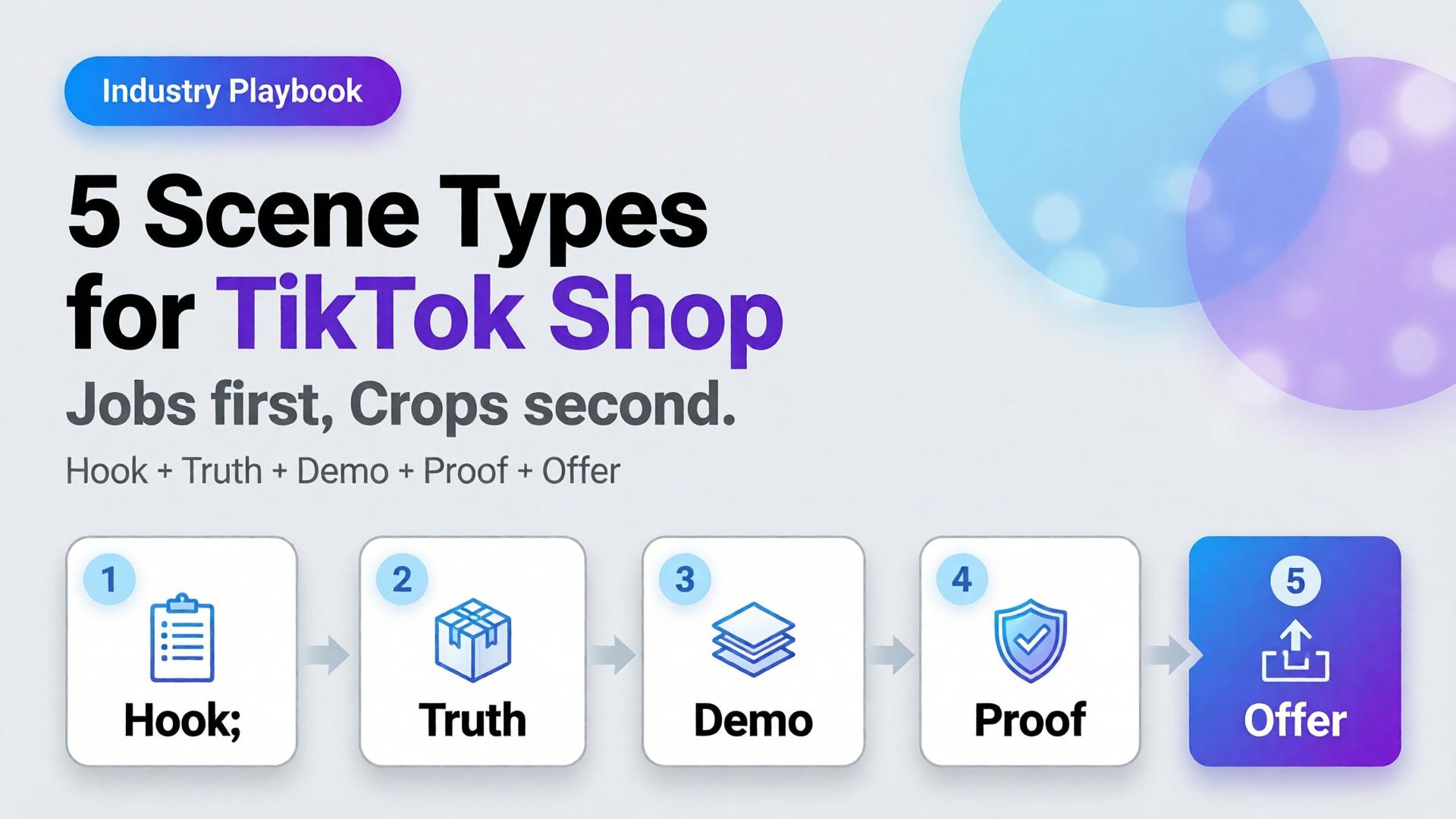
AI TikTok Shop product images work when you cast scenes by job, not by aesthetic. Five scene types cover almost every SKU drop: hook, truth, demo, proof, offer.
Key Takeaways
>
– Treat TikTok Shop creative as a scene system, not a single hero crop.
– Listings and ads with richer visual coverage convert more strongly — large listing studies show 5+ images correlating with ~50% higher conversion versus thin galleries (Catchlab via 2026 image stats roundups).
– High-quality product photography still shows outsized lifts versus weak imagery in Salsify-cited analyses (~94% better conversion vs low-quality photos in 2026 roundups).
– Pair scene types with ratio families (1:1, 4:5, 9:16) — scene job first, crop second.
Sibling to marketplace banner thinking. Parent frame: AI Ecommerce Design Is Not AI Image. Story structure: SCENE.
Why Do Random Lifestyle Renders Underperform on TikTok Shop?
Because the feed is a conversation, not a catalog wall.
| Buyer second | Question | If your image answers nothing |
|---|---|---|
| 0–1s | Why pause? | Scroll |
| 1–3s | What is it really? | Distrust |
| 3–8s | How does it work / look on me / in use? | Bounce |
| CTA | Why buy now? | Save for later forever |
A single “aesthetic” AI frame usually answers only the pause — and sometimes not even that. Scene types map to the questions in order.
On TikTok Shop, clarity is a growth hack. Aspiration without truth reads as dropship. Truth without a hook never gets seen.
The 5 Scene Types (Jobs, Not Vibes)
1. Hook — stop the scroll
Job: Pattern interrupt that still belongs to your brand.
- Strong silhouette, motion freeze, unexpected scale, bold color block
- Product recognizable within one beat
- No tiny label text as the hook
Fail mode: generic luxury room that could sell anyone’s bottle.
2. Truth — show the real SKU
Job: Marketplace-grade honesty. Geometry, label, color.
This is packshot thinking inside the ad system — front / 45° / detail as needed.
Fail mode: AI-rewritten typography, warped proportions, beauty that lies.
3. Demo — show the use
Job: Hands, pour, wear, open, apply — the verb of the product.
- One action per frame
- Match real physics (no fake steam on shelf-stable drinks)
Fail mode: model posing beside product with zero interaction.
4. Proof — reduce risk
Job: Texture macro, size reference, kit contents, before/after only if honest.
Proof is not fake UGC. It is visual evidence the PDP will keep.
Fail mode: invented reviews as image text; exaggerated results.
5. Offer — carry the deal without killing trust
Job: Price, bundle, or urgency laid on a still-true product frame.
- Safe zones for text
- Same product identity as Truth scene
Fail mode: redesigning the product to make room for a sticker.
How Do Scene Types Map to Ratios?
Use banner thinking — one master direction, many crops:
| Scene | Best first ratio | Also ship |
|---|---|---|
| Hook | 9:16 | 4:5 |
| Truth | 1:1 | 4:5 |
| Demo | 9:16 | 4:5 |
| Proof | 1:1 | 4:5 |
| Offer | 9:16 + 1:1 | cover/wide if store needs |
Do not invent five unrelated worlds. Invent five jobs inside one brand kit.
Playbook: One SKU, One Day
- Write the five jobs in one line each (hook idea, truth angle, demo verb, proof detail, offer frame)
- Lock reference — phone or studio plate that survives Truth gate
- Generate Hook + Demo in explore-limited mode after kit lock
- Generate Truth + Proof reference-heavy — reject label drift
- Build Offer from Truth master + text safe zone
- Crop to 9:16 / 4:5 / 1:1 from winners (node: Crop)
- Contact-sheet review — do the five still look like one brand?
This is the TikTok Shop version of phone → campaign.
What Changes by Category?
| Category | Hook bias | Demo bias | Proof bias |
|---|---|---|---|
| Beauty | Texture / glow ritual | Application | Shade / skin-safe honesty |
| Fashion | Outfit world | On-body movement | Fabric macro / fit |
| F&B | Condensation / pour | Serve moment | Ingredient / label truth |
| Gadgets | Scale / unbox silhouette | Feature in hand | Port / detail accuracy |
Beauty teams already map rituals in lifestyle context mapping. TikTok Shop simply forces the order of jobs into the feed.
Soft CTA
Produce Shop-ready scene families and ratio sets in one workspace: Marketplace Banners · Ecommerce
Frequently Asked Questions
What are the best AI TikTok Shop product images?
Images assigned to clear jobs — hook, truth, demo, proof, offer — with locked product fidelity and consistent brand kit across ratios.
Do I need video if I have strong still scene types?
Stills still matter for Shop cards, carousels, and ads. Video helps demo and hook; it does not replace Truth and Proof frames.
How many scenes should I generate per SKU?
Start with one winner per type (five). Expand variants only after the five jobs pass a set review.
Is this the same as marketplace banner thinking?
Banner thinking solves ratios. Scene types solve narrative jobs. You need both: job first, then crop.
Can AI lifestyle replace packshots on TikTok Shop?
No. Lifestyle without Truth increases returns and distrust. Keep a truth layer even when the hook is cinematic.
What is the biggest AI mistake on TikTok Shop creatives?
Generating twelve “nice” lifestyles with no demo verb and no label-true hero — volume without jobs.
Conclusion
TikTok Shop does not buy your moodboard. It buys scenes that do jobs.
Hook to earn the pause. Truth to earn trust. Demo to earn understanding. Proof to remove fear. Offer to invite the tap. Crop each winner into the ratios the channel demands.
That is how AI TikTok Shop product images stop looking like stock — and start behaving like a sales system.
References
- Lumepixa, AI Product Photography Statistics 2026 (Salsify / Catchlab citations). https://lumepixa.app/blog/ai-product-photography-statistics
- Lumepixa, Product Image Statistics 2026. https://lumepixa.app/blog/ecommerce-product-image-statistics
- Adobe, 2026 Creators’ Toolkit Report, June 16, 2026. https://news.adobe.com/news/2026/06/creators-toolkit-report-2026