A sofa on pure white tells dimensions badly. A sofa in a cathedral living room tells lies well. Home and furniture ecommerce lives in that tension: buyers need context, but context that invents square footage creates “looked bigger online” returns.
AI home product staging is the discipline of placing SKUs in believable rooms with scale honesty, locked light, and gates — not generating dream interiors that your warehouse cannot ship.
Key Takeaways
>
– White-only home catalogs under-inform; fantasy rooms over-promise. Use dual-layer galleries like visual commerce 2026.
– Stage with known scale anchors (door, outlet, side table) and real product dimensions in the brief.
– Map rooms like beauty maps rituals — a context grid before generate (SCENE).
– Geometry still matters for legs, seams, and hardware (hard goods QA when parts are precise).
Why Does Home Staging Break Trust Online?
Because furniture is purchased as space math.
| Staging sin | Buyer consequence |
|---|---|
| Oversized rooms | “Tiny in real life” returns |
| Wrong camera height | Proportions feel off |
| Mixed design eras | Brand looks incoherent |
| Soft rug hiding feet | Leg style unknown |
| Invented materials on props | Cart confusion |
Lifestyle lift is real in ecommerce image research — but only when lifestyle stays honest.
Home staging is not interior design porn. It is dimensional storytelling: how big, how it sits, how it lives with ordinary walls.
Context Map for Home SKUs
Borrow beauty’s context mapping mindset (beauty lifestyle contexts):
| Context | Job | Avoid |
|---|---|---|
| Studio / white | Spec + color truth | Only image on PDP |
| Apartment daylight | Real-life scale | Mansion windows |
| Corner / tight wall | Small-space proof | Endless open plan |
| Detail / fabric | Material truth | Fake weave |
| Lifestyle lived-in | Emotion | Clutter that hides SKU |
Write 4–5 contexts per hero SKU. Reuse the room kit across the catalog (batch thinking).
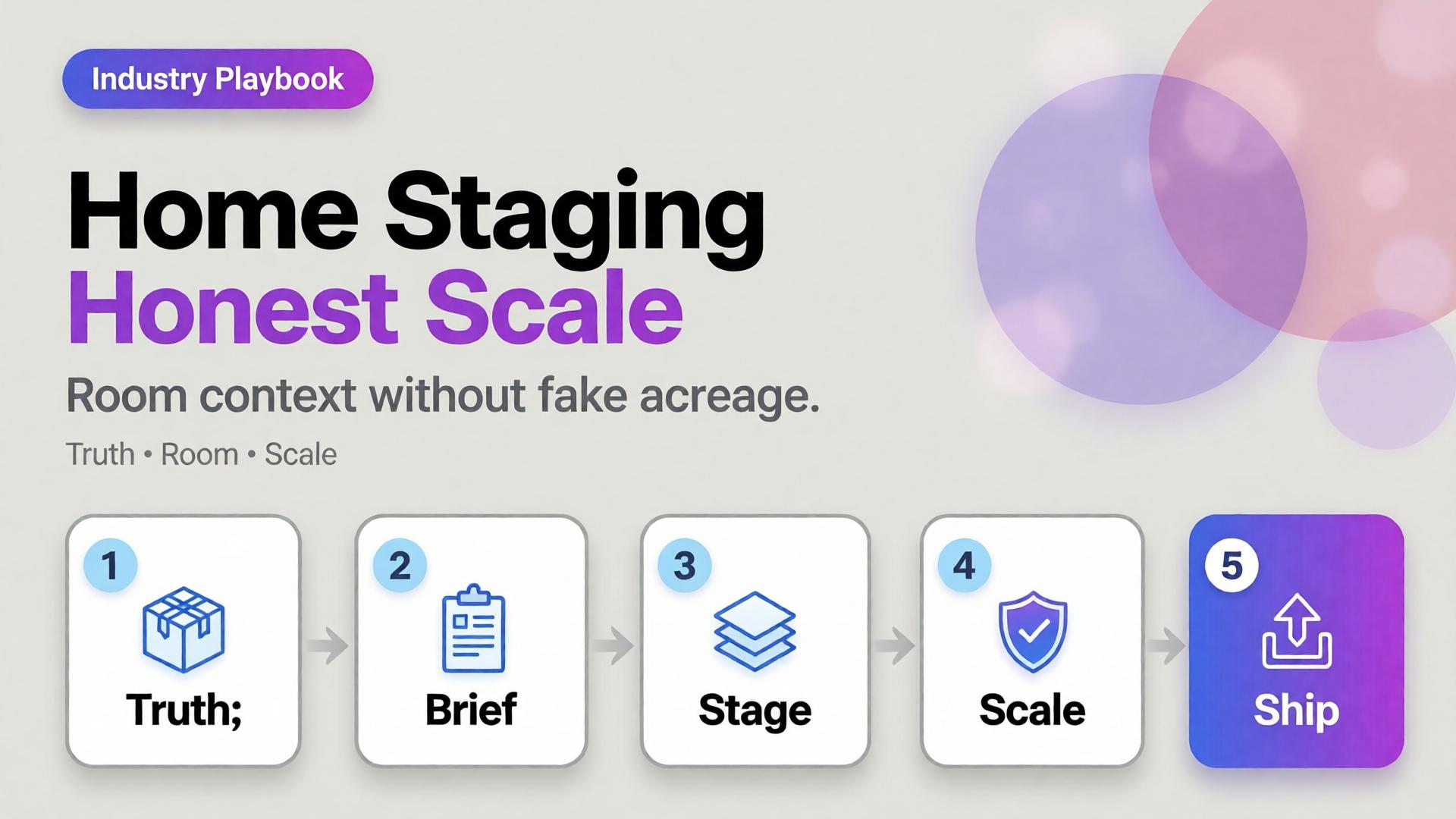
Playbook: Honest Room Extension
- Lock packshot truth — front, side, fabric detail
- Write room brief — room size class (studio / 1BR living), camera height, light (north window / warm lamp)
- Place scale anchors — known objects; state approximate room width in brief if critical
- Generate staging with product ref locked
- Scale QA — does the SKU dominate the room unrealistically?
- Ship dual layer — truth + staging for PDP; staging-heavy for ads
Soft CTA
Produce catalog truth and room contexts in one ecommerce creative system: Ecommerce · Photography
Frequently Asked Questions
What is AI home product staging?
Placing furniture or home SKUs into room contexts with AI while preserving product fidelity and believable scale for ecommerce.
Should every furniture PDP drop white backgrounds?
Keep a truth layer. Add staging as secondary images and ads — same dual-layer logic as visual commerce guidance.
How do I prevent “mansion staging”?
Specify room class and camera height in the brief. Reject outputs where the SKU looks doll-sized or palace-scaled.
Can staging replace dimensions in the listing?
No. Staging supports intuition; specs remain mandatory.
Conclusion
Rooms sell home products. Fake acreage unsells them after delivery.
Map contexts. Lock scale. Gate the fantasy. Keep a truth layer. That is AI home product staging that converts without breeding return tickets.
References
- Lumepixa, Product Image Statistics 2026. https://lumepixa.app/blog/ecommerce-product-image-statistics
- Adobe, 2026 Creators’ Toolkit Report, June 16, 2026. https://news.adobe.com/news/2026/06/creators-toolkit-report-2026