Virtual try-on promises “see it on me.” Too many AI ads deliver “see a stranger wearing almost your SKU.” Necklines drift. Sleeve lengths invent themselves. The face is gorgeous — and the garment is fiction.
AI virtual try-on ads work when you treat try-on as fit storytelling: garment truth first, character second, filter effects never.
Key Takeaways
>
– Try-on is a garment fidelity problem with a human in frame — not a beauty filter with clothes attached.
– Lock garment refs like hard goods lock geometry (hard goods QA); lock faces like character design.
– Use try-on for Demo / Proof jobs in Shop scene types — not as every hook.
– Zero-reshoot colorways: swap garment refs inside one pose world (3-day lookbook).
Why Do Try-On Ads Fail After the Click?
Because the ad sold a face mood and the PDP shows a different garment.
| Ad promise | PDP reality | Result |
|---|---|---|
| Perfect drape | Stiffer fabric | Return |
| Shorter hem | True length | Distrust |
| Model body match | Size chart ignored | Size chaos |
| New face every frame | Brand amnesia | Low recall |
Try-on without gates burns paid traffic.
Shoppers forgive AI skin. They do not forgive AI seam lines. Fit storytelling starts at the stitch, not the smile.
What Must Be Locked for Honest Try-On?
Garment bible
- Silhouette, neckline, sleeve, length, closure
- Print scale and placement
- Fabric category (knit / woven / sheer)
Character rules (if face/body shown)
- One anchor identity across the set
- Body proportions stable enough for size intuition
- No “new cousin” every creative
Scene job
- Demo: on-body motion or turn
- Proof: detail of fit at shoulder/waist
- Hook: only after garment passes
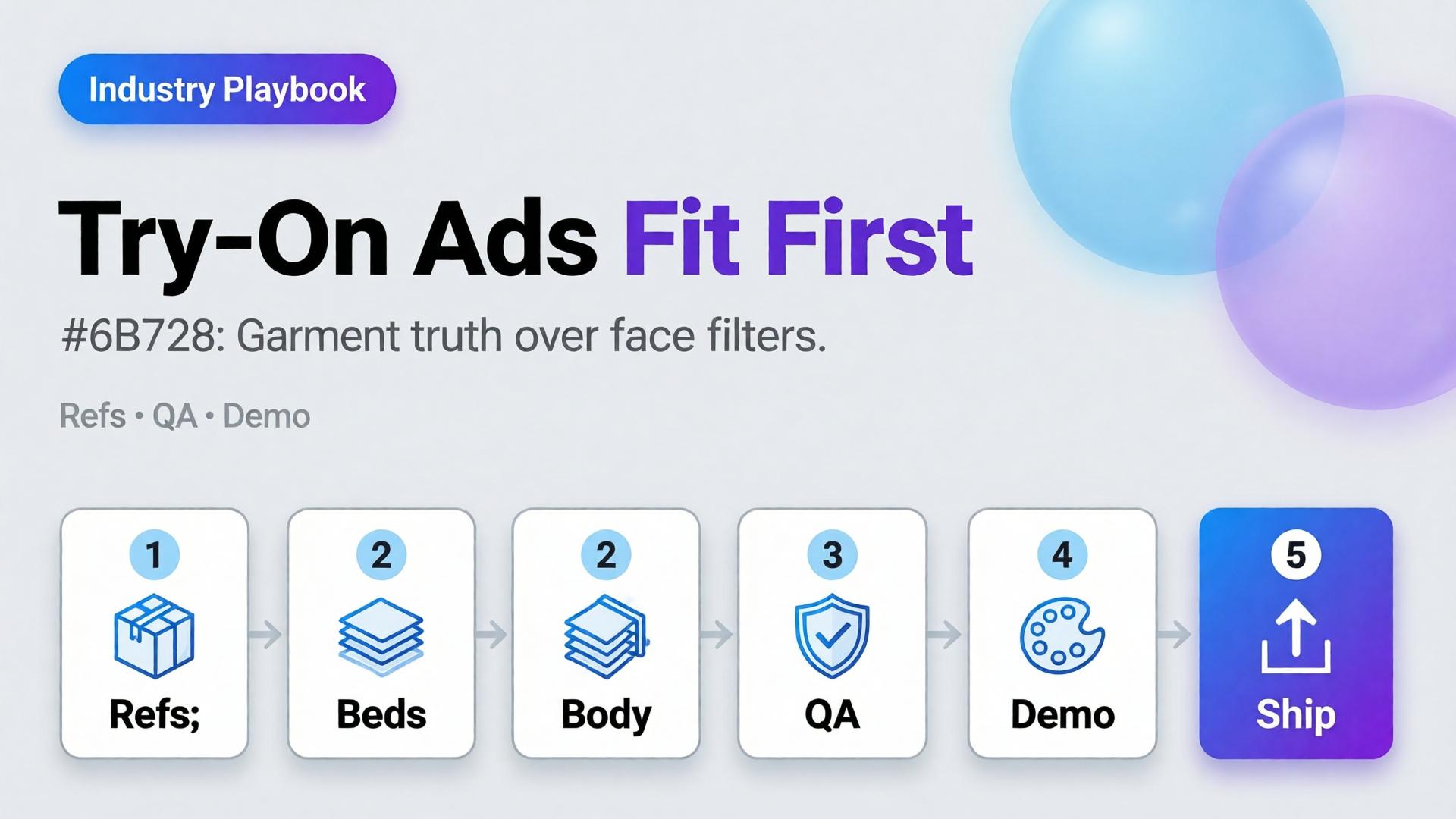
Playbook: Try-On Without Filter Energy
- Capture garment refs — flat + on-hanger + detail
- Approve a base on-body still reference-heavy
- Garment QA gate — zoom hems, necklines, prints
- Extend to ads — crop to 9:16 / 4:5; do not regenerate identity per ratio
- Colorway variants — swap garment ref only; keep pose/world
- Reject beauty-only winners that fail garment match
Pair with lookbook world rules (lookbook needs a world).
Soft CTA
Build listing and on-body stills from real garment refs: Listing Images · Gallery
Frequently Asked Questions
What makes AI virtual try-on ads trustworthy?
Garment fidelity under zoom, stable character, and clear Demo/Proof jobs — not maximal beauty scores.
Do I need a different model for try-on vs packshots?
Choose for the fidelity bottleneck after direction. Try-on usually needs stronger reference lock than lifestyle exploration.
Can try-on replace size charts?
No. It supports intuition. Charts and measurements remain mandatory.
How many try-on frames per SKU?
One approved on-body hero + one detail proof beats six drifted beauties.
Conclusion
Stop shipping face filters in dresses. Ship fit stories.
Lock the garment. Gate the seams. Keep one character. Use try-on where Demo and Proof matter. That is how AI virtual try-on ads earn clicks that survive the PDP.
References
- Adobe, 2026 Creators’ Toolkit Report, June 16, 2026. https://news.adobe.com/news/2026/06/creators-toolkit-report-2026
- Lumepixa, Product Image Statistics 2026. https://lumepixa.app/blog/ecommerce-product-image-statistics