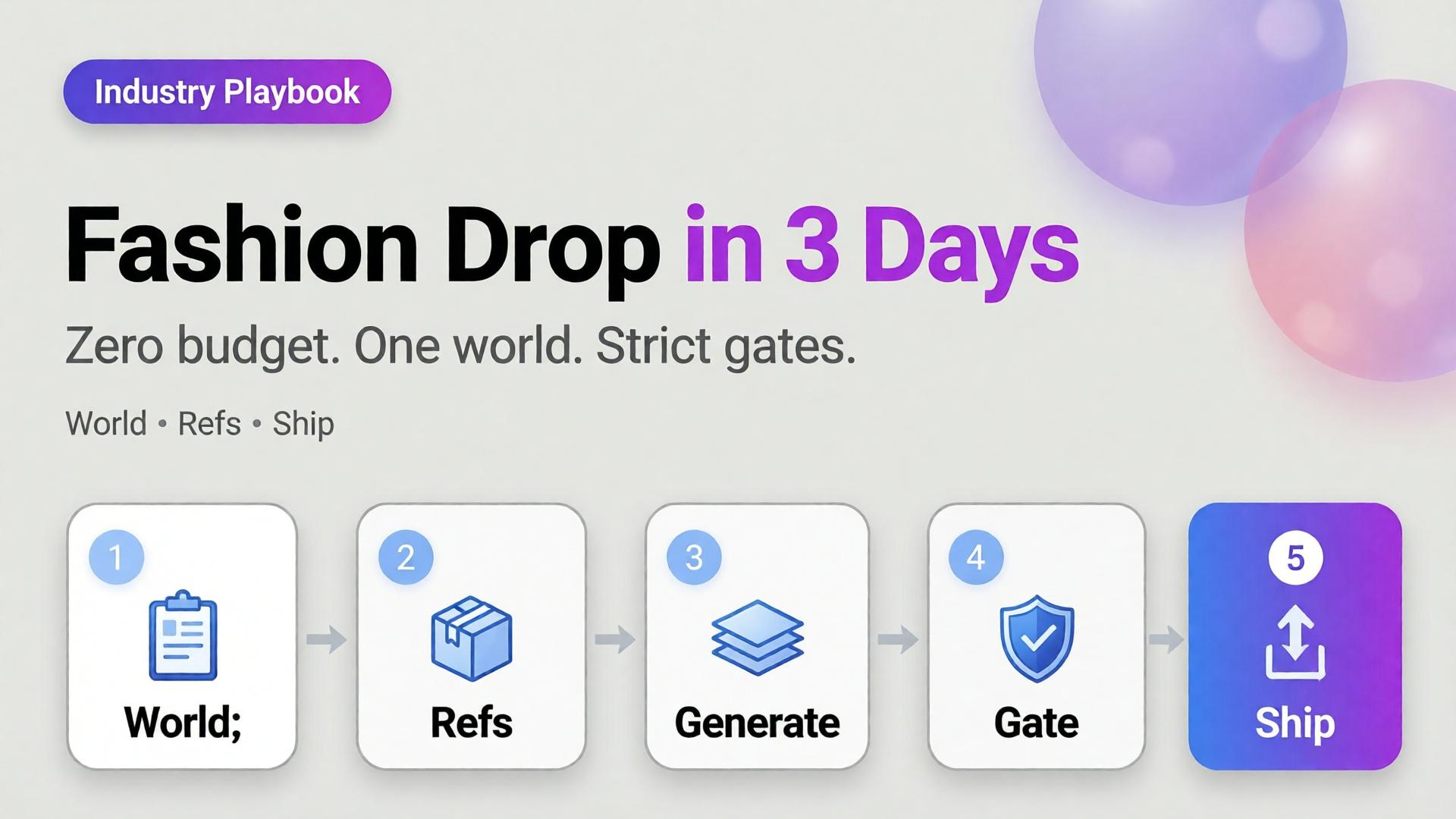
You have twelve SKUs, one phone, no studio booking, and a drop date that will not move. The agency quote is a fantasy. The Instagram moodboard is a trap. What you need is not “more AI fashion.” You need a three-day playbook that produces a coherent lookbook without a budget line for production.
AI fashion lookbook small brand success is almost never about the prettiest single render. It is about one world, honest garment references, and curator gates that kill cousins before they publish.
Key Takeaways
>
– Zero budget does not mean zero direction. It means world + refs + gates instead of studio days.
– Pillar idea still holds: a lookbook needs a world, not a studio.
– Adobe’s 2026 report: 57% of creators say AI outputs need moderate or extensive editing before publish — plan curator time into the three days (Adobe, 2026).
– Reuse one character / light family across outfits; change garments, not identity — see face consistency when a model face repeats.
This is the SME fashion spoke under lookbook thinking. Experiment sibling: 1 outfit × 8 scenes.
What Does “Zero Budget” Actually Mean?
It means you will not buy:
- Studio day
- Pro model booking (optional: founder / friend as anchor face)
- Agency art direction retainer
It does not mean you skip:
- A written world paragraph
- Flat-lay or on-hanger garment refs
- A reject pile
Zero budget without gates produces a folder of beautiful strangers wearing almost-your-clothes.
Small brands fail AI lookbooks when they try to buy agency aesthetics with scrap references. The fix is fewer scenes, stricter world, better refs — not a bigger model.
The 3-Day Playbook
Day 1 — World, kit, references (no heavy generating)
Morning — Write the world (10 lines max)
- Place (rooftop golden hour / concrete stair / apartment window)
- Season and light logic
- Emotion (sharp calm / weekend ease / night out)
- No-go (neon cyber, beach club, marble bathroom if off-brand)
This is lookbook thinking compressed — world before wardrobe.
Afternoon — Capture garment truth
For each SKU:
- Front flat or hanger
- Back / detail if print or hardware matters
- Color in daylight if possible
Phone is enough. Crooked is okay. Lying labels are not.
Evening — Lock character decision
- No face / hands-only / one anchor face
- If face: three anchors + bible (character design rules)
Gate end of Day 1: world paragraph approved, refs named, face decision frozen.
Day 2 — Generate inside the world (not across the planet)
Morning — Scene map (not 30 ideas)
Pick 6–8 scenes max for the drop:
| Scene | Job |
|---|---|
| Hero standing | Catalog recognition |
| Walk / motion freeze | Life in garment |
| Detail crop | Fabric / stitch truth |
| Seated / lean | Attitude |
| Pairing / layer | Styling story |
| Wide environmental | World proof |
Use SCENE in one line per scene — skip novel-length prompts.
Afternoon — Reference-heavy generation
- Garment ref always on
- World locked
- Explore mode only for background micro-variants after one hero scene passes
Read reference vs explore before you “just try something wild.”
Evening — Hard curator pass
Reject:
- Wrong sleeve length / neckline
- Fabric that turned into another mill
- Face cousins
- World leaks (suddenly beach)
Adobe’s 57% edit rate is your calendar: leave hours for rejects, not only for generates.
Day 3 — Adapt, sequence, ship
Morning — Build the lookbook sequence
Order matters: world establish → hero SKUs → detail breaths → closer.
Afternoon — Channel crops
- Lookbook PDF / site grid
- 4:5 feed
- 9:16 story/reel covers
Same masters; different jobs — do not regenerate a new identity per ratio.
Evening — Publish set review
View the full set as one brand. If SKU seven looks like a different label, it does not ship.
Clothes Variants Without a Reshoot
When you need a second colorway:
- Keep pose / world / character locked
- Swap only the garment reference
- Gate color accuracy against the real SKU
- Do not “prompt the color” from memory
That is the small-brand version of zero-reshoot varianting — still honesty-first.
What to Skip on Purpose
| Skip | Why |
|---|---|
| 20 scene ideas | Dilutes world |
| New face per outfit | Breaks memory |
| Luxury stock locations you cannot own | Feels rented |
| Text-heavy fashion posters in hero frames | AI typography risk |
| Publishing every “good enough” frame | Volume ≠ lookbook |
Batch thinking still applies: one kit, many SKUs — not one prompt per hanger.
Soft CTA
Build listing and lookbook stills from real garment refs in one creative workspace: Listing Images · Gallery
Frequently Asked Questions
Can a small brand really ship an AI fashion lookbook in three days?
Yes — if Day 1 is discipline (world + refs), Day 2 is gated generation, and Day 3 is sequence and crops. Skipping Day 1 guarantees chaos.
How is this different from general AI lookbook thinking?
The pillar explains why world beats studio. This playbook is the calendar for SMEs with no budget line.
Do I need a professional model?
No. Hands-only or one consistent anchor face often reads more honest for small brands than a rotating cast of AI faces.
How many outfits can I cover in three days?
Typically one drop family (8–15 SKUs) if refs are ready. More SKUs need the same world but extra curator hours — not extra worlds.
What if garment fidelity keeps failing?
Improve references and lighting truth before changing models. Most “model problems” are ref problems.
Should I mix AI looks with real phone photos?
Yes — phone truth for ecom details, AI for world extension, clearly sequenced. Hybrid sets often feel more trustworthy than all-AI fantasy.
Conclusion
Zero budget is not a creative death sentence. It is a constraint that forces lookbook thinking.
Day 1: world and refs. Day 2: generate inside gates. Day 3: sequence and ship. Change outfits, not identity. Reject cousins. Crop masters instead of reinventing them.
That is how a small brand ships an AI fashion lookbook that looks like a brand — not like a weekend with a random image model.
References
- Adobe, 2026 Creators’ Toolkit Report, June 16, 2026. https://news.adobe.com/news/2026/06/creators-toolkit-report-2026
- Adobe, Inaugural Creators’ Toolkit Report (Adobe MAX 2025), October 28, 2025. https://news.adobe.com/news/2025/10/adobe-max-2025-creators-survey