You launch in one language. Then marketplace ops asks for EN, VI, TH, and ID versions of the same banner by Friday. Someone regenerates the whole scene four times. The bottle changes shape. The light shifts. The brand kit quietly dies.
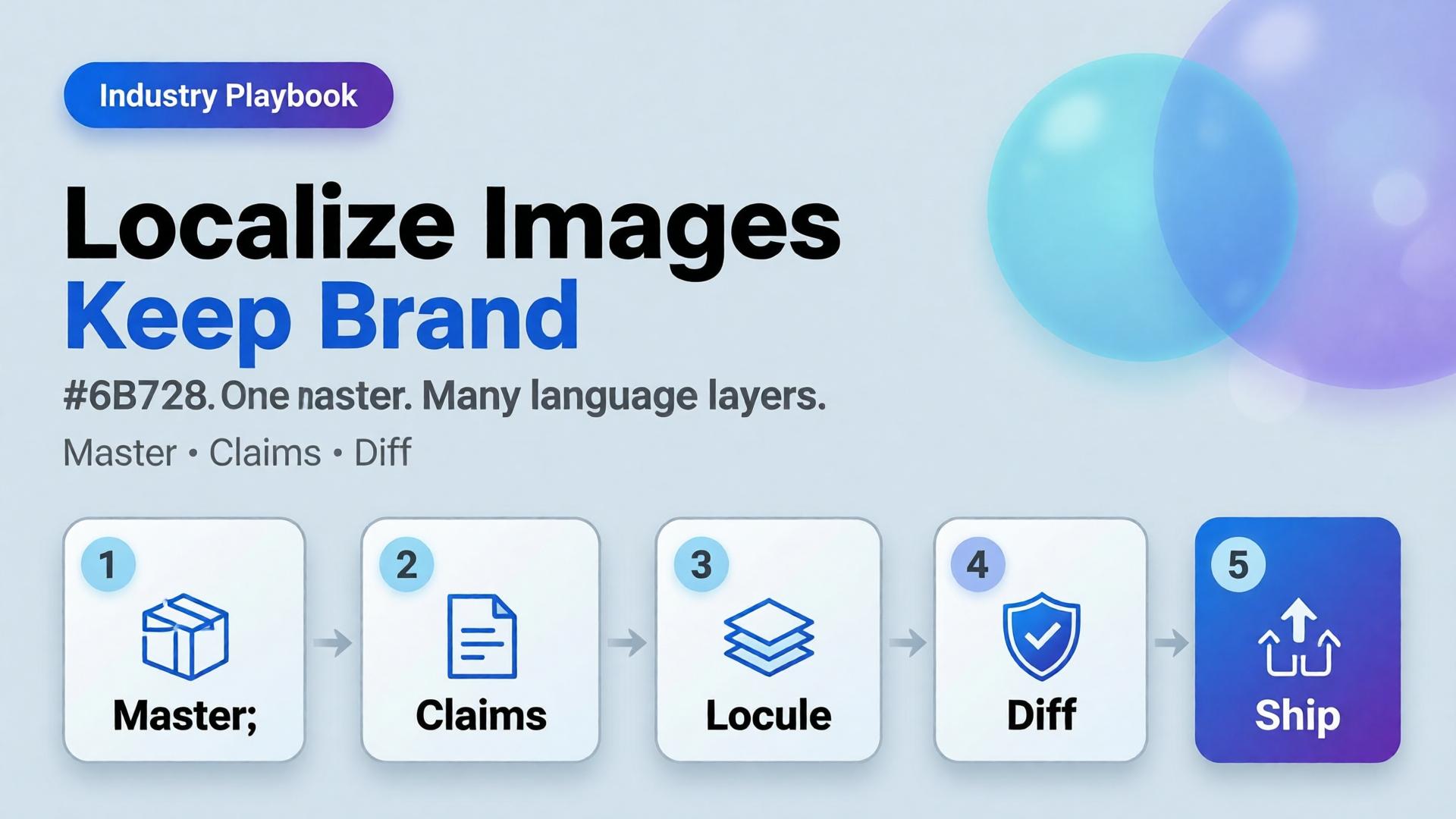
AI ecommerce image localization is not “translate and pray.” It is a production rule: one visual master, many language layers — with gates that protect SKU truth and brand identity across borders.
Key Takeaways
>
– Rebuild-per-language is how catalogs fracture. Localize text and claims, not the entire world, unless the market truly needs a new scene.
– High-quality product imagery remains a conversion lever in 2026 roundups (Salsify-cited lifts vs weak photos); localization must not destroy that quality (Lumepixa, 2026).
– Treat localization as a node after Brand Style + Generate — never as a fresh creative brief.
– Legal claims, units, and badge rules are market-specific gates — not prompt adjectives.
Why Do Per-Language Regenerations Break Brands?
Because generation optimizes for a new pretty frame, not for identity continuity.
| Rebuild-per-language | Master + localize |
|---|---|
| New light each market | Same light family |
| Label drift risk × N | One Truth gate |
| Four art directions | One kit |
| Slow QA | Diff-check text regions |
Cross-border teams do not need more models. They need batch thinking applied to locales.
Localization fails when teams translate campaign vibes instead of translating claims. Vibes can stay global. Claims must go local.
What Should Stay Global vs Go Local?
Keep global (master layer)
- Product geometry and packshot truth
- Brand palette and light logic
- Scene world / lifestyle context (unless culturally wrong)
- Character identity if a face is used
Localize deliberately
- In-image headlines and CTAs
- Promotional badges and price callouts
- Measurement units and regulatory lines
- Marketplace-required disclaimers
Redesign only when required
- Cultural taboo in scene
- Model casting rules by market
- Category compliance that forbids the original composition
If you redesign every time, you do not have a localization system. You have N brands.
Playbook: Master → Locale Pack
Step 1 — Ship a language-agnostic master
Prefer compositions with clear text safe zones (marketplace banner thinking). Avoid burning essential claims into tiny packaging type you cannot legally alter.
Step 2 — Extract a claim sheet per market
| Field | EN | VI | Notes |
|---|---|---|---|
| Hook line | … | … | Char limit |
| Offer badge | … | … | Color locked |
| Unit line | oz | ml | Compliance |
| Disclaimer | … | … | Legal review |
Step 3 — Localize as a gated node
Input: approved master + claim sheet. Output: locale variants. Gate: geometry unchanged, brand kit intact, text correct, no new product.
Step 4 — Diff review, not vibes review
Flip EN ↔ VI on the same crop. If the bottle moved, reject — even if Vietnamese typography looks nicer.
Step 5 — Archive locale packs with the kit
Next drop swaps SKU refs, reuses locale claim templates. That is how cross-border catalogs scale.
Where AI Helps — and Where It Lies
Helps: rapid text replacement in safe zones, layout fitting, bulk varianting after master lock.
Lies: rewriting packaging legal text “to look native,” inventing certificates, changing ingredient panels, or “improving” the product silhouette while translating.
Packshot honesty still applies (packshot thinking). A localized ad that misrepresents the SKU creates returns in every language.
Soft CTA
Keep one ecommerce creative system across markets: Ecommerce solutions · Marketplace Banners
Frequently Asked Questions
What is AI ecommerce image localization?
It is the practice of adapting in-image text and market claims on a locked visual master so catalogs stay consistent across languages and marketplaces.
Should every market get a unique lifestyle scene?
Only when culture or compliance demands it. Default to one world, many language layers.
Can AI translate text printed on the product package?
Treat package print as high risk. Prefer accurate photography of the real SKU for Truth frames; localize marketing overlays separately.
How do I QA localized images quickly?
Side-by-side diff against the master. Check geometry first, typography second, claim accuracy third.
Where does this sit in a workflow builder?
After Generate and before Upscale/Crop variants — localization should not invent a new product.
Conclusion
Cross-border growth should multiply locales, not multiply identities.
Lock a master. Write claim sheets. Localize as a node. Diff-check like a skeptic. Keep the bottle the same bottle.
That is AI ecommerce image localization that scales — without quietly founding a new brand in every language.
References
- Lumepixa, AI Product Photography Statistics 2026. https://lumepixa.app/blog/ai-product-photography-statistics
- Adobe, 2026 Creators’ Toolkit Report, June 16, 2026. https://news.adobe.com/news/2026/06/creators-toolkit-report-2026