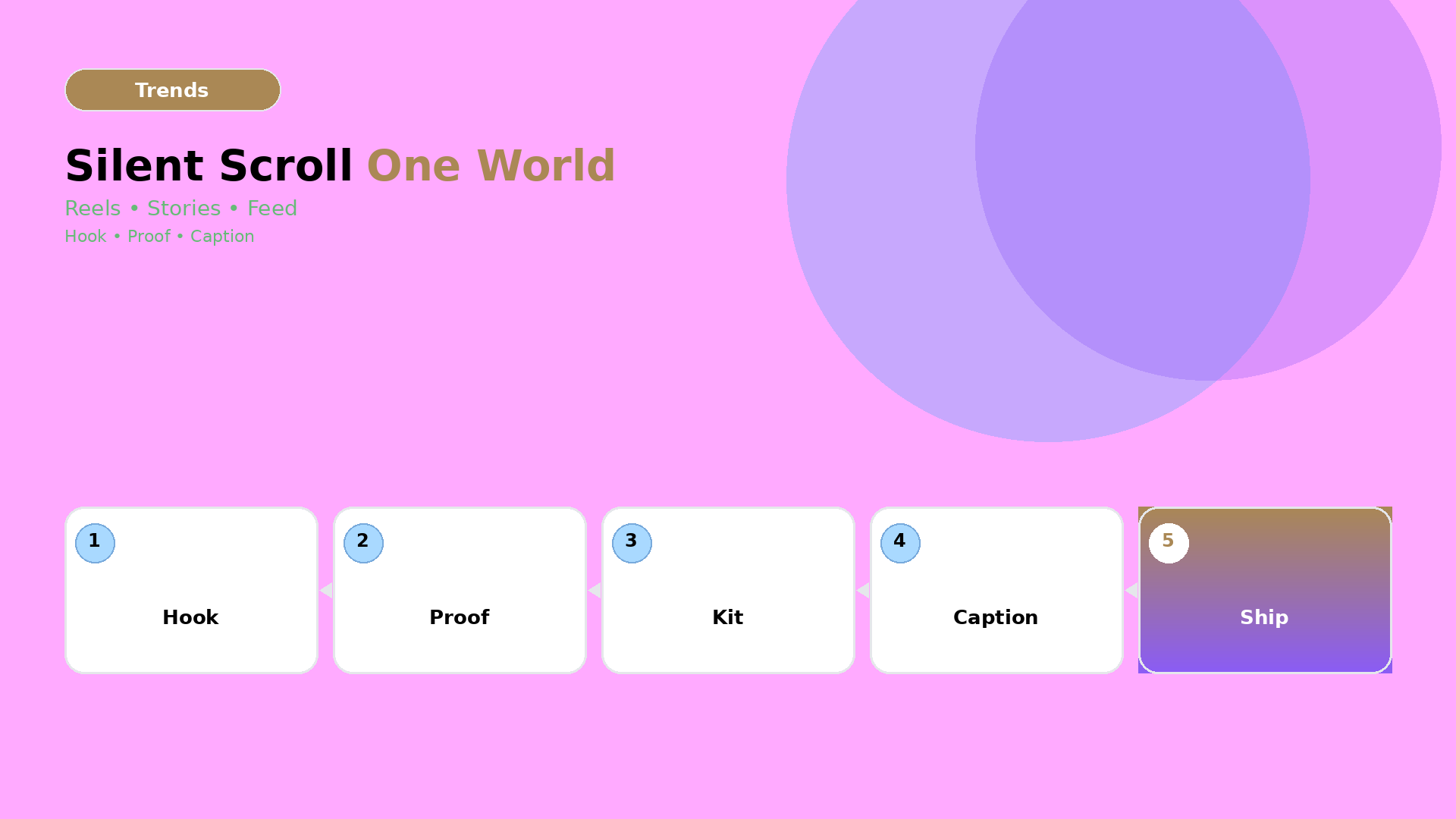
In 2026, “ads” are not just videos.
They are micro-worlds: hook, attention cue, product truth, and a caption tone that doesn’t contradict the visuals.
The safest way to ship is to design for the silent reality first.
Key Takeaways
– Silent scroll is a design constraint, not a platform setting.
– Build one One World Kit (world + light + motion rules), then generate channel-safe variants.
– Your QC checklist should verify attention readability and brand voice consistency, not just “looks good”.
The silent scroll rule
When people watch without sound, they evaluate your ad with three fast checks:
- Can I instantly tell what it is?
- Does the first second communicate value?
- Is the tone consistent with what I expect from this brand?
If your hook relies on narration, you’re designing for a minority of viewers.
One World Kit: what it includes
Think of your kit as a set of rules shared by every cut:
World rules (the “why”)
- tone: calm, premium, playful, energetic
- claim boundaries: what you can say safely
- storyline: problem → transformation → offer
Visual rules (the “how”)
- product truth: no warped geometry
- light family: shadow style stays within a range
- motion language: what changes per scene vs what stays fixed
If your world is unstable, your audience treats each output as a new brand. That’s exactly the failure mode behind the “brand consistency trap”.
Scene planning for IG (reels, stories, feed)
Use scene planning like a template system:
| Channel | Primary goal | Scene emphasis |
|---|---|---|
| Reels | Hook + fast value | attention cue in first 1–2s |
| Stories | Continuation + clarity | product truth before any stylization |
| Feed | Offer + credibility | longer hold on proof frame |
This is where the SCENE method matters: you’re not generating “a video”, you’re generating a set of scenes with fixed roles.
Hook structure that survives silent viewing
Good hooks for silent scroll usually contain:
- a visual transformation cue (before/after or “reveal” moment),
- an on-frame value hint (short text, safe zones),
- a rhythm rule (no waiting for narration).
Even if you generate with AI, your hook should be designed, not discovered.
QC checklist (the parts that actually fail)
Before you ship, verify:
- First-second readability: can the product be recognized without motion blur?
- Text timing: does the value text appear before the scene gets busy?
- Caption tone: does the caption agree with the visual promise?
- Kit stability: is the face/character consistent across variants (if used)?
If any item fails, you don’t “regenerate randomly”. You go back to the gate: update the world kit or lock the missing constraint.
What to do next
If you already have TikTok Shop scenes, you can reuse the mindset:
But the IG upgrade is to prioritize silent readability and one-world kit stability.
Ship weekly drops with templates:
- Workflow Builder: https://orauria.com/workflow
- Studio Guide: https://orauria.com/studio-guide