The scared story says AI generates better copy.
The accurate story is quieter: AI can write, but it cannot reliably align your voice with your offer across formats.
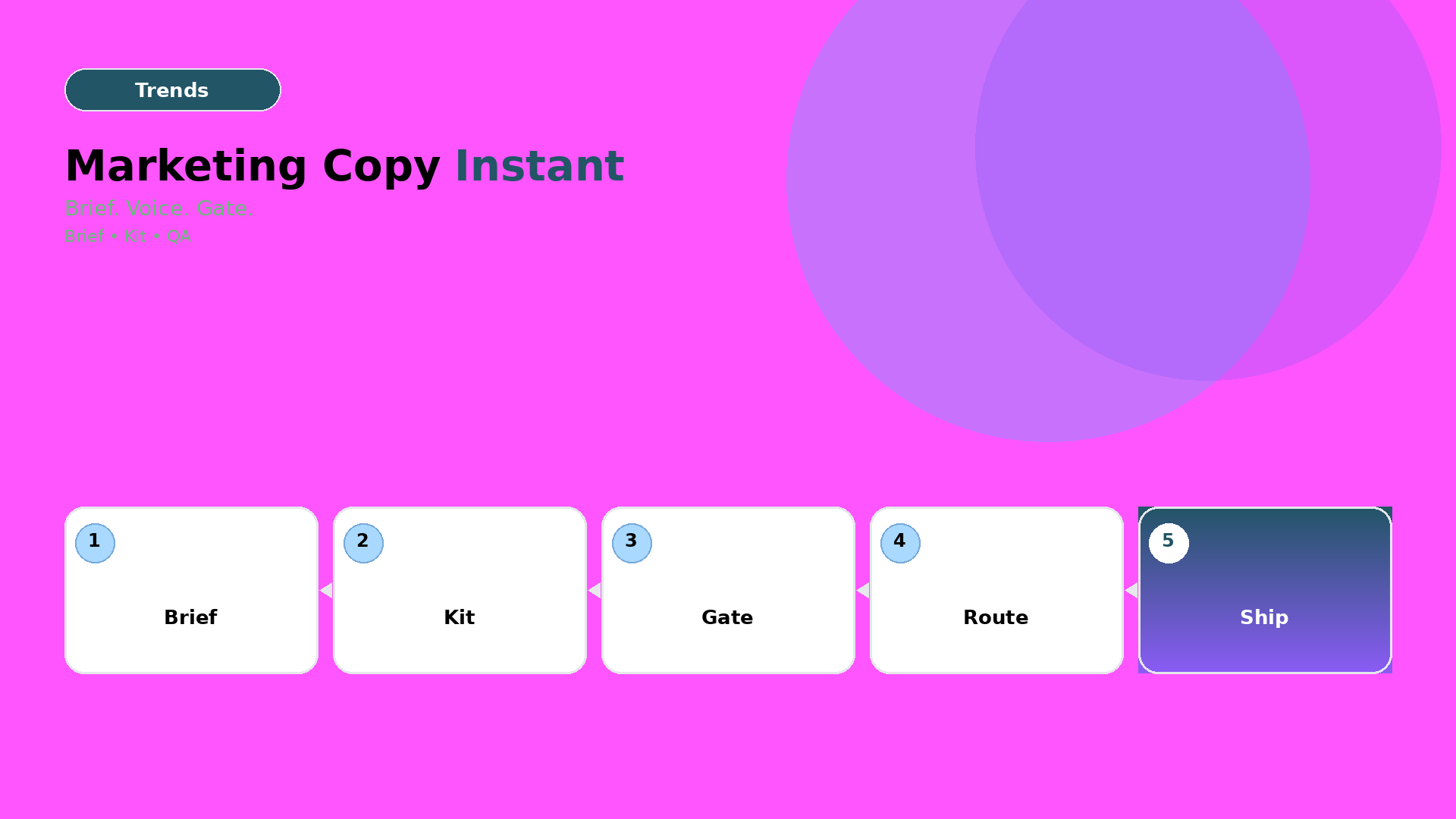
So the real bottleneck becomes a human gate: brief → intent → constraints → voice → output.
Key Takeaways
– The problem is rarely “language quality”. It’s alignment drift between your brand kit and the generated text.
– Use a Brief-to-Caption Gate: copy should not be “prompted”, it should be routed and checked.
– A good copy workflow ships as templates + rules, not as one-off prompts.
Why marketing copy fails in AI workflows
Copy fails when you treat it like:
- a standalone text task (no kit),
- a new prompt per channel (no gates),
- or a “rewrite until it sounds good” loop (no constraints).
That’s how you get three versions of the same message:
- ad copy that overpromises,
- caption that under-explains,
- product-page tone that doesn’t match the campaign.
The audience notices. Even if they don’t read every word.
The Brief-to-Caption Gate (3 layers)
1) Brief layer: compress the job into 3 lines
Use your existing template:
- Buyer (who it’s for)
- World (setting/tone)
- Close (desired response)
If your brief can’t be spoken in one breath, your copy will splinter into variants.
2) Constraints layer: attach the brand kit rules
Before generating anything, lock:
- tone (serious vs playful),
- claim safety (what you can’t say),
- formatting rules (CTA style, length ranges),
- “no-go phrases” and “must-keep phrasing”.
Think of this like a kit checksum: copy either passes it or gets re-routed.
3) Gate layer: QA the output, then approve
QA questions that catch most failure modes:
| QA check | What you prevent |
|---|---|
| Does it match the 3-line Close? | Wrong offer / wrong CTA |
| Are claims precise (no vague superlatives)? | Overpromising & mismatch |
| Does tone stay inside your kit rules? | Voice drift across formats |
| Can you reuse it across channels? | “One ad, one prompt” waste |
A workflow you can reuse in every campaign
Follow this loop:
- Lock: brief + kit constraints (one time per campaign)
- Draft: generate 6–10 caption variants (fast)
- Gate: filter by QA checks (strict)
- Route: pick 1 winner per channel (ad / reel / product)
- Ship: export the final kit into your content system
This is the same mindset as node thinking: you’re building a reusable graph, not a queue of random prompts.
If you want the exact framework for “upload → brand style → generate → upscale → crop”, start with:
Example: turning a short brief into 3 formats
Given a brief for a skincare drop:
- Buyer: busy beauty shoppers
- World: calm, late-night routine
- Close: “buy now, first-time protection”
Your workflow generates:
- an ad caption that reads like a promise (but stays claim-safe),
- a reel script with a silent-suitable hook,
- a product-page microcopy that repeats the same Close without sounding repetitive.
The important part: every output shares the same gate-approved core.
What to do next
If you’re already generating copy, the biggest upgrade is to stop writing prompts from scratch.
Create your Brief-to-Caption Gate once, then reuse it across weekly drops.
Start here: