AI makes it easy to generate “studio shots”.
But studio shots are not a guarantee of trust.
Sometimes the right world is the fake studio.
Sometimes the right world is real lifestyle.
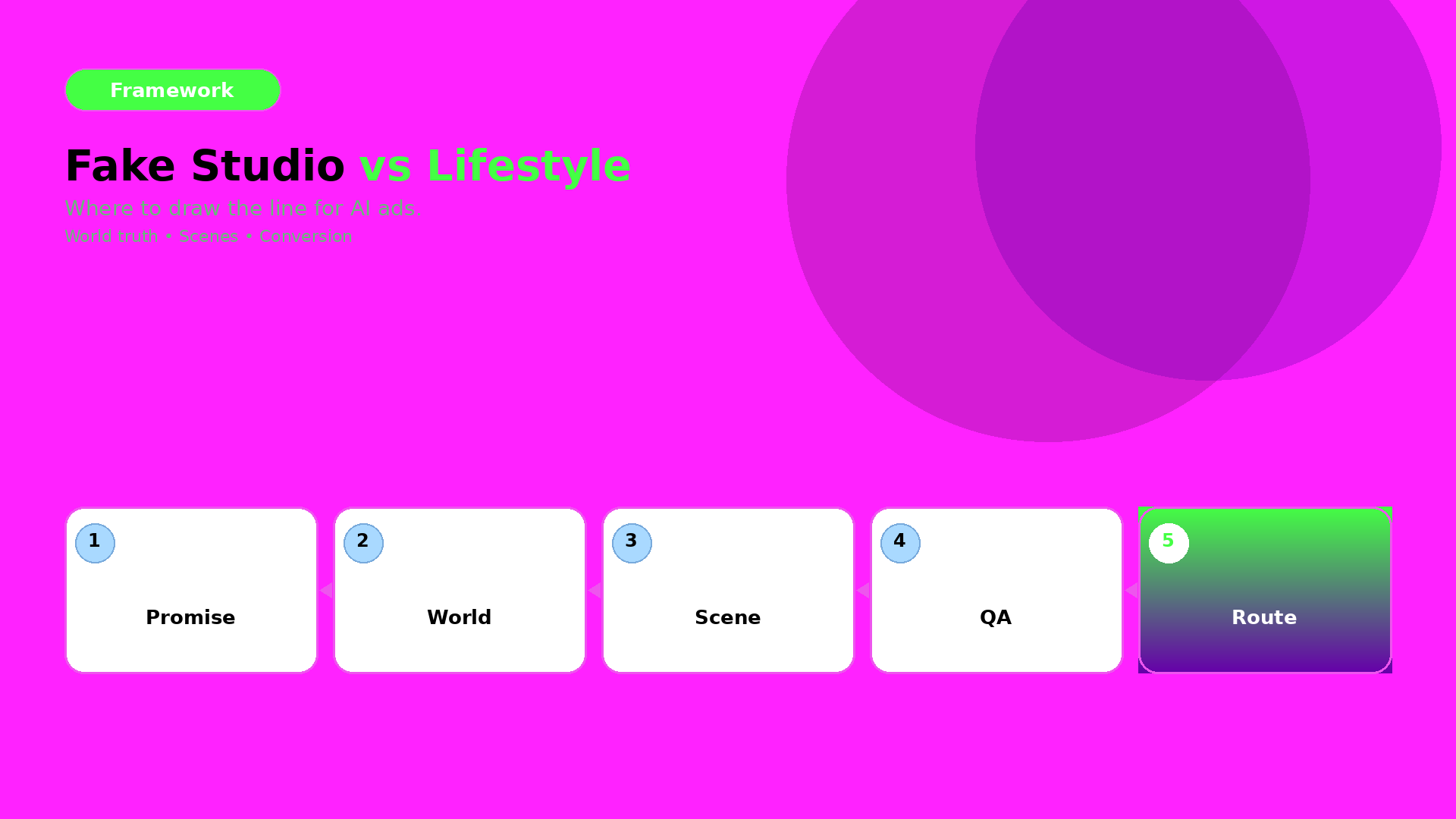
The framework is simple:
You do not choose by aesthetics. You choose by world truth—what the buyer expects before they decide.
Key Takeaways
– Fake studio is not “bad”. It is a tool with a job slot.
– Lifestyle works when the offer depends on context and ritual.
– QC is not “pretty”. QC is whether the scene keeps the same world promise.
The decision framework (Promise → World → Scene)
1) Promise (what you are trying to sell)
Ask: what does the buyer need to believe?
- Geometry truth (fit, labels, texture)? → studio-like proof frames can work.
- Ritual truth (how it is used, felt, timed)? → lifestyle wins.
2) World (the continuity system)
World includes:
- light family (shadow style and temperature),
- background logic (real-world coherence),
- and tone (premium, calm, energetic).
If world rules are missing, both studio and lifestyle outputs drift.
3) Scene roles (assign responsibilities)
Scenes should have roles:
- hook frame (value instantly),
- proof frame (product truth),
- offer close (CTA + tone).
When you assign roles, you can mix studio-like proof with lifestyle context without contradiction.
QC gates: how you prevent the “it feels wrong” moment
Use gates that catch world mismatch:
- Shadow family gate: does the shadow style match the kit across scenes?
- Texture truth gate: do labels and textures stay readable after resizing?
- Context coherence gate: does the lifestyle setting make sense for the product’s promise?
- Offer tone gate: does the caption imply the same promise as the visuals?
If one gate fails, you update the world kit. You do not “regenerate until it looks better”.
What to do next
Start with lifestyle context mapping for beauty and ritual-driven offers:
Then expand the same framework to any category with:
- proof frames (studio-like),
- and story scenes (lifestyle-like).