AI doesn’t break lookbooks because it’s “bad at images”.
It breaks lookbooks because it treats every scene as a standalone moment.
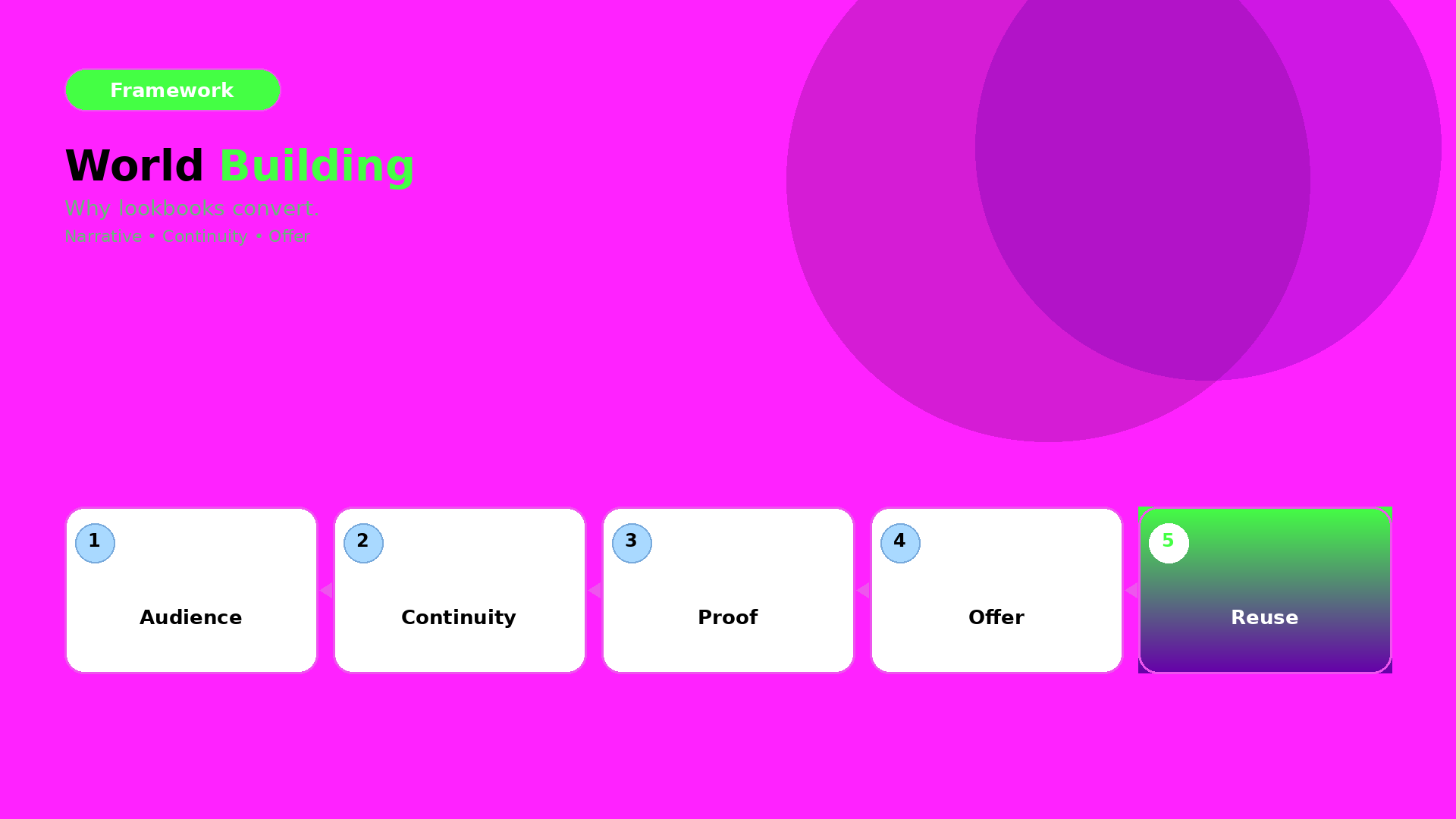
World-building fixes this by making every scene belong to the same fictional—and commercial—world.
Key Takeaways
– A lookbook world is a continuity system: rules that survive across scenes.
– World-building turns “many images” into a repeatable drop calendar.
– QA becomes measurable when you test continuity, not vibes.
What is “lookbook world building”?
World-building is the layer that defines:
- Continuity (what must stay identical)
- Scene roles (what each scene is responsible for)
- Offer repetition (how the buyer gets the same message safely)
In production terms:
- World rules create stability (light family, palette logic, texture truth)
- Scene roles create clarity (hook frame, proof frame, offer close)
- Offer repetition creates conversion consistency (CTA + claim tone)
Why AI needs world rules (not just prompts)
When you don’t define world rules, you get:
- random shadow styles per scene,
- character drift (face, hair, identity cues),
- geometry “almost-right” that buyers feel as uncertainty,
- captions that imply different promises in different formats.
World rules are your answer.
A simple world kit you can reuse
Lock a small kit once, then reuse it:
- Light family: morning-soft, editorial-hard, or evening-warm (pick one logic)
- Palette logic: background tones and product accent colors stay within a range
- Continuity anchors: product geometry, label readability, character silhouette
- Claim safety rules: what you can promise repeatedly without overclaiming
This is not an aesthetic moodboard. It is a set of constraints.
Scene roles: assign responsibilities, not random scenes
Use scene roles like a checklist:
- Hook role: first frame tells value
- Proof role: texture + details that justify claims
- Offer role: CTA and close promise
- Reuse role: later scenes that can be resized into ads without contradiction
When every scene has a role, the drop feels like a system—not a scatter.
QA gates (how you prevent world collapse)
Before you export, verify:
- Continuity anchors still match (identity + geometry range)
- World light stays inside the light family
- Offer tone stays consistent with the campaign claim
If one gate fails, update the world kit—not the entire pipeline.
What to do next
Start by turning your lookbook into roles:
- build 1 world kit,
- generate 3 scenes,
- run QA gates,
- then scale to a full drop schedule.
If you want the scene workflow, pair this with: