Most lookbooks fail with AI for one simple reason:
They start from images instead of directions.
Directions are your brand’s continuity contract. Once directions are locked, scenes become repeatable production jobs—not random aesthetic roulette.
Key Takeaways
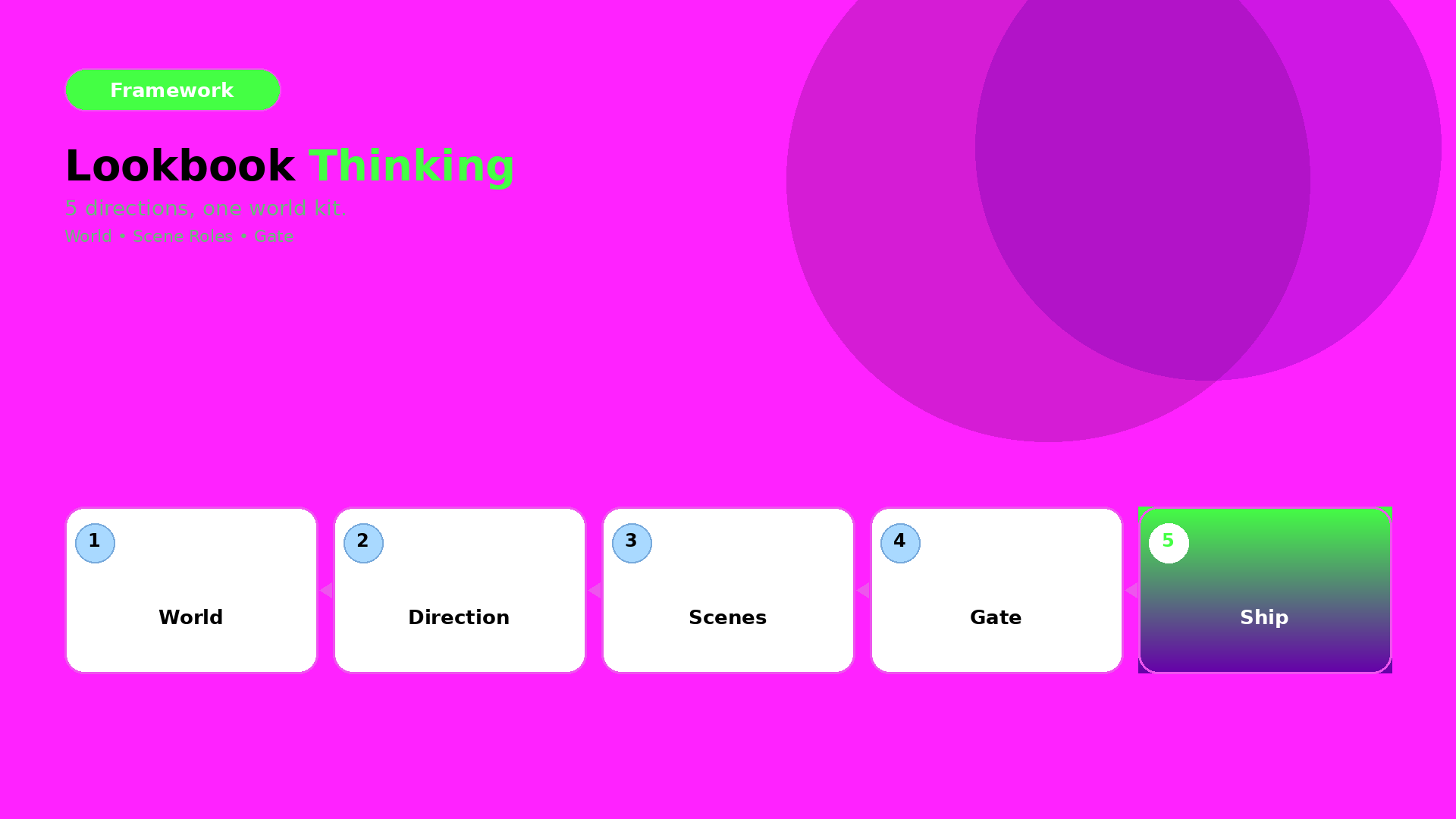
– A lookbook needs creative directions (world + roles), not more variations.
– Lock 5 directions, then map scenes, channels, and formats to the same world kit.
– QA is not “does it look pretty?” QA is “does the world stay consistent?”
What is a creative direction in a lookbook?
A creative direction answers three questions:
- What is the world? (setting, light family, mood)
- Who are the roles? (character identity, behavior rules)
- What is the offer? (what the buyer should feel and do)
Without roles, AI drifts. Without world rules, the drop looks like different seasons.
The 5 directions that sell (and reuse easily)
1) The Everyday Ritual
Product as a habit. Calm pace, honest texture, soft proof.
Use it for: skincare routines, casual apparel, “wear it daily” offers.
2) The “Reveal” Story
Before/after movement. The first frame must communicate the value instantly.
Use it for: seasonal upgrades, styling transformations, upgrade-to-new-version messages.
3) The Social Proof Frame
Receipts before claims. Strong composition, minimal clutter, credible atmosphere.
Use it for: bundles, limited drops, “most ordered” positioning, trust-building pages.
4) The Location Mood
Same product identity, different narrative location.
Use it for: city traveler looks, vacation capsule wardrobes, lifestyle fit moments.
5) The Product Truth Close
Geometry and details first. Tight proof for texture, stitching, labels, and fit cues.
Use it for: e-commerce PDP support, reseller listings, marketplace creatives.
How do you apply directions to scenes?
Treat each direction as a scene role template:
- World rules stay stable (light family, palette logic)
- Role rules stay stable (character identity, behavior)
- Only the scene variable changes (location, outfit item, action)
This is the same mindset behind:
QA gates: what to check before you ship
If you want directions to hold across formats, your QA checklist must include:
- facial identity continuity (jawline, skin tone range, hair silhouette)
- product geometry truth (no warped edges, stable label readability)
- world continuity (shadow style and color temperature stay inside the kit)
- offer continuity (CTA and claim tone match the direction’s “why”)
What to do next
If you’re planning a weekly drop, start with the smallest win:
Lock one direction, generate 6–10 scenes, and enforce the QA gates.
Then scale to five directions once your world kit passes.