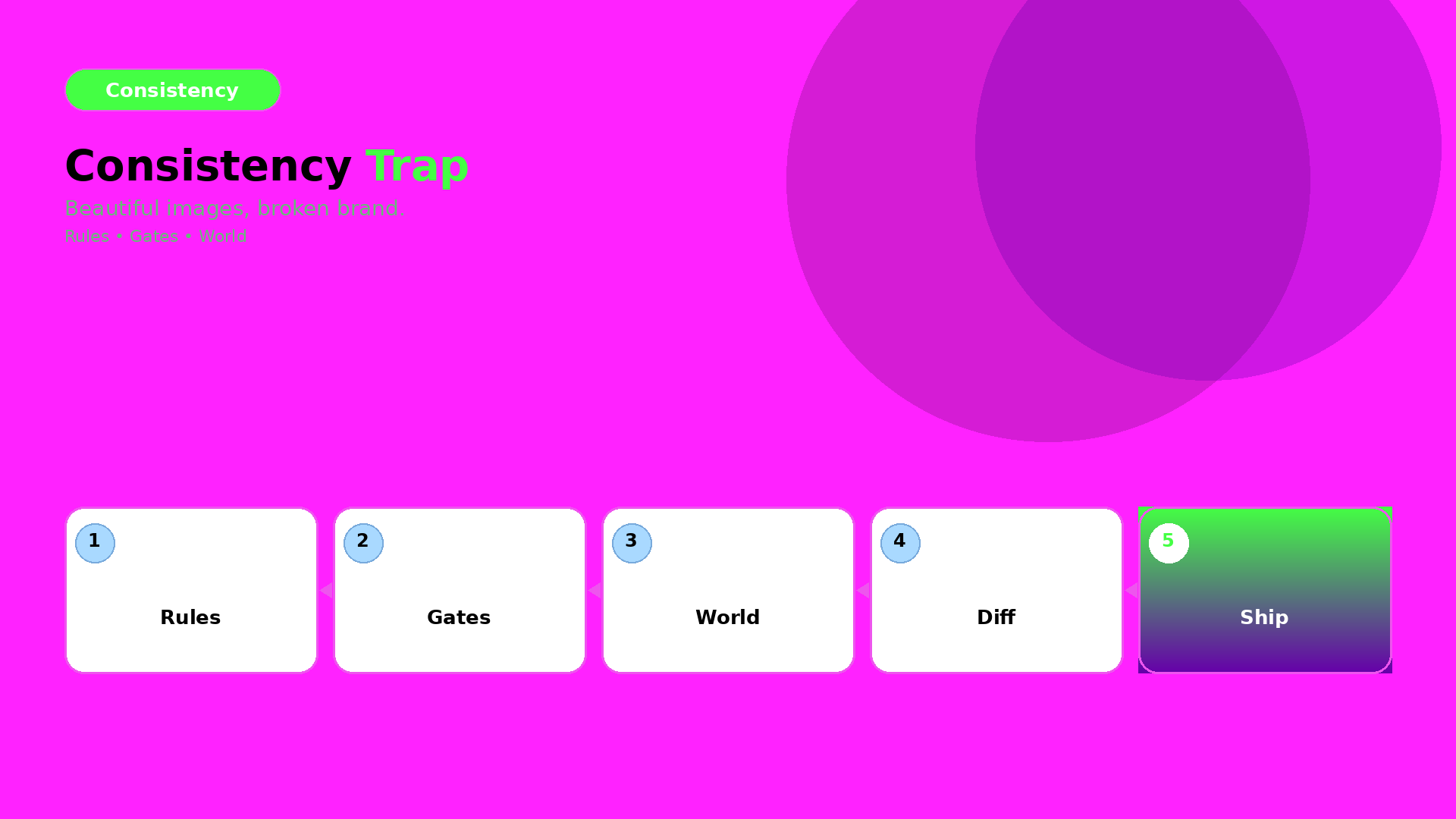
Consistency is the one thing AI can’t “handle for free”.
It can generate a beautiful frame every time. But your audience doesn’t buy frames. They buy recognition.
And recognition only happens when your brand’s rules survive across scenes, formats, and drops.
Key Takeaways
– The consistency trap is thinking “pretty” equals “aligned”.
– Visual identity needs rules (what must not change) and gates (how you verify it).
– World kits turn many outputs into one recognisable brand.
What the trap looks like (in production)
You ship a lookbook or a set of ecommerce creatives.
Everything looks fine… until:
- faces feel slightly different across images,
- shadows change style between scenes,
- product texture looks inconsistent after resizing,
- your captions promise a different “why” than the visuals show.
Each issue is small. Together they train buyers to doubt the brand.
The real cause: missing “brand rules”
Most teams don’t define rules. They define prompts.
Prompts are flexible. Rules are strict.
If your workflow has no strict rules, the model will “solve” each output independently. That creates drift.
Build a consistency system: Rules → Gates → World
1) Rules (what must not change)
Pick a small set of invariants:
- face/character identity anchors (identity range, hair silhouette, skin tone logic),
- texture/label clarity rules (what makes the product “real”),
- shadow and light family (shadow style + color temperature range),
- typography and CTA style (if text appears, it must follow the same rules).
Rules define “identity space”. Everything outside that space gets rejected.
2) Gates (how you verify identity quickly)
Use QC gates that catch drift early:
- geometry truth gate: edges + proportions within range,
- readability gate: label/CTA still readable after resizing,
- world gate: light family matches kit constraints,
- promise gate: copy tone matches the visuals’ implied offer.
Gates are checklists, not opinions.
3) World kit (how rules become repeatable outputs)
World kit is your consistency contract:
- same world logic across scenes,
- same role structure (hook / proof / offer),
- the same routing rules for which model to use when bottlenecks change.
Once your world kit exists, you can scale without losing recognition.
What to do next
Start with one brand rule set and one world kit:
- lock identity anchors,
- define light family,
- build QC gates,
- then generate and export.
If you want supporting frameworks: