Most model comparisons fail because they do not compare the same bottleneck.
They ask:
“Which model looks best?”
For ecommerce, the better question is:
“Which model preserves product truth under our QA gates?”
Key Takeaways
– Stop ranking models by aesthetics.
– Rank by geometry truth, texture fidelity, and label clarity.
– Choose a model after creative direction—not before.
Experiment design (so the result is real)
1) Lock the direction
Use one direction kit:
- one world setup (light family + palette logic),
- one angle brief (angles that answer buyer questions),
- one QA checklist (what must not break).
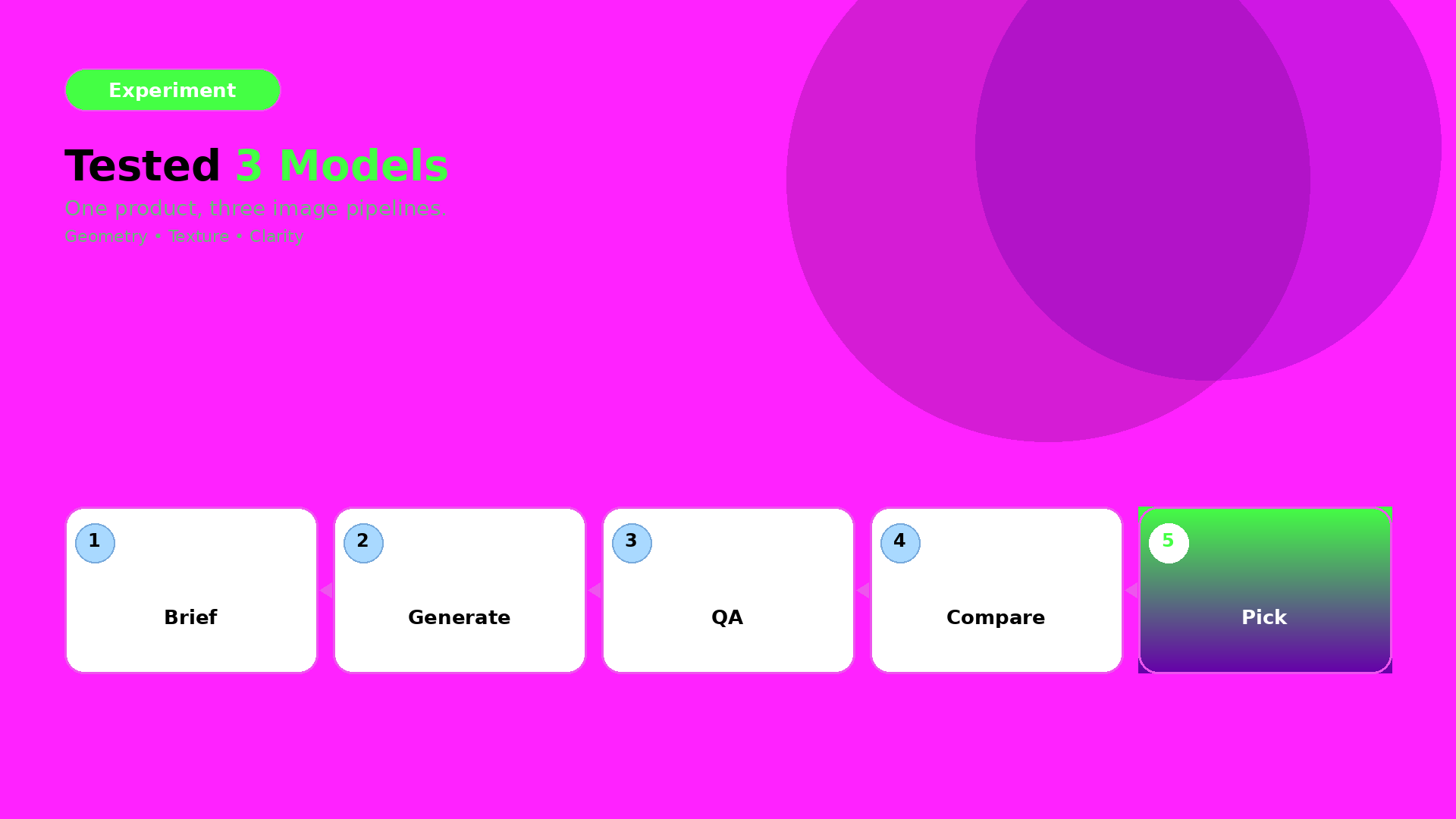
2) Generate with three models
Run the same direction kit across three image model families.
Do not change prompts between models.
Let the test measure what matters.
3) QA gates (where winners are decided)
Check:
- geometry stability (edges, proportions),
- texture fidelity (fabric, material cues),
- label readability (after resizing),
- shadow family consistency.
4) Export the same outputs
Export comparable sizes:
- feed-safe square,
- ad-safe vertical,
- and marketplace listing proof.
If a model looks good on one size but fails on another, it is not your winner.
What to do next
If you want the framework:
Then run this 3-model QA experiment whenever your bottleneck changes:
- new product category,
- new label density,
- or new scene world.