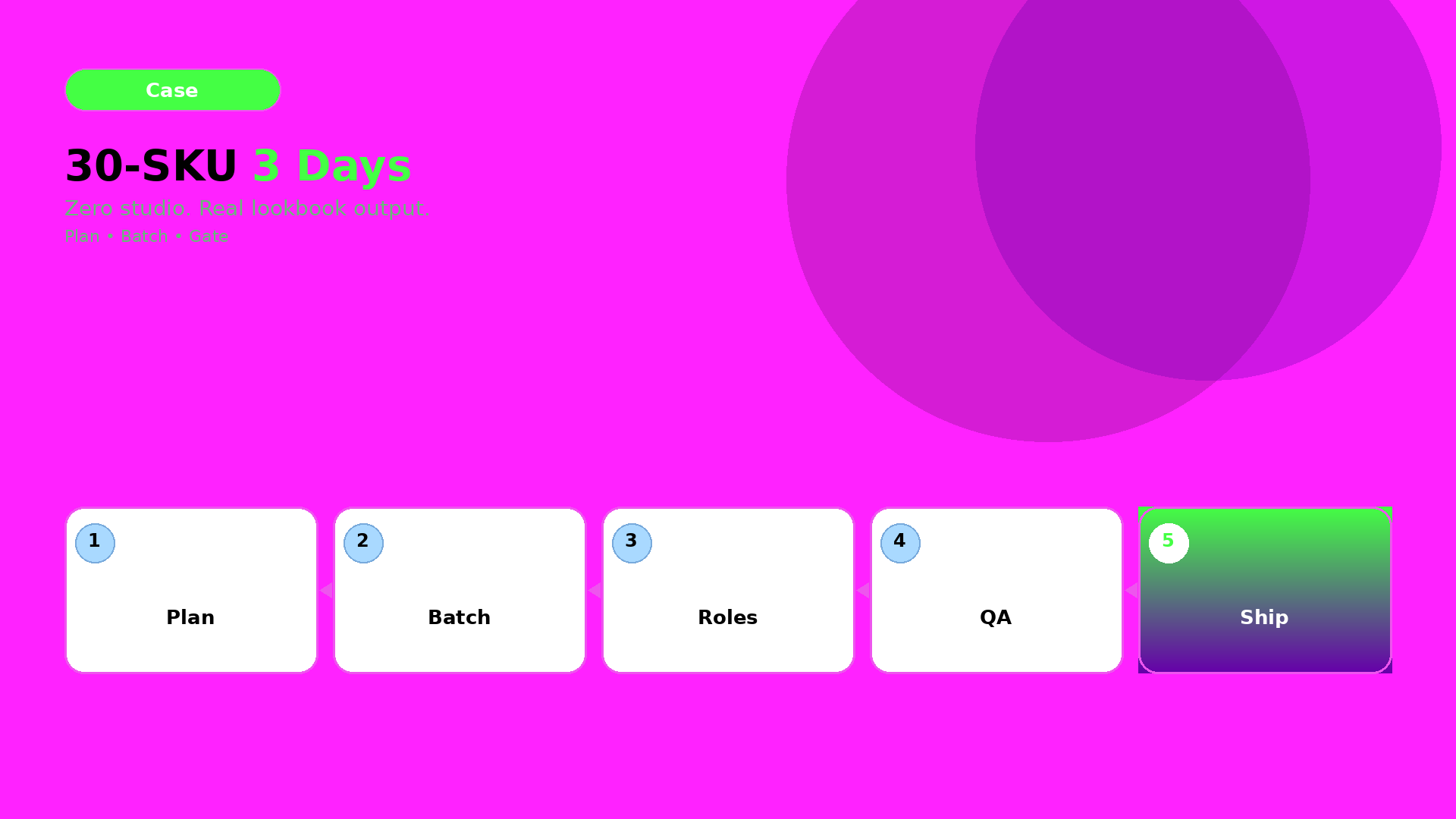
This case is not about “fast rendering”. It is about fast decisions under constraints.
A 30-SKU shop had no studio time. The goal was a lookbook that could also be reused for ads and marketplace listings.
The bottleneck
When you generate lookbook scenes quickly, your real failure modes are:
- identity drift (faces/characters not stable),
- world collapse (shadows and tone change scene to scene),
- and QA blindness (geometry or label readability fails after resizing).
So the case success is measured by: continuity + QA gates + reusable roles.
Experiment setup (what we locked first)
World kit
- one light family (shadow logic stays inside a range),
- one palette logic (background + product accents),
- one continuity anchor set (identity + product geometry truth).
Creative directions (roles)
We used lookbook thinking:
- hook role: first-second value,
- proof role: texture + label readability,
- offer role: CTA and promise tone,
- reuse role: later export into ad-safe formats.
Scene grid plan
30 SKUs were not treated as 30 independent projects. They were mapped into a batch:
- same world kit,
- roles repeated across scenes,
- only the SKU variable changes.
The 3-day schedule (how speed actually happened)
Day 1 — Plan + role map
Lock directions and world kit. Write the QA checklist before any generation.
Day 2 — Generate batches
Generate scenes per role, not per SKU. Reject drift candidates early so we don’t waste polish time.
Day 3 — QA gates + export
Run the gates and export channel-safe variants:
- lookbook page frames,
- ad-ready crops,
- marketplace listing support frames.
QA gates used (what got checked every time)
We used four gates:
- Identity gate: continuity anchors match across scenes.
- Geometry gate: edges and proportions stay stable.
- Readability gate: labels/CTA remain legible after resizing.
- Offer gate: captions imply the same promise as the visuals.
If any gate fails, we update the kit (rules), then regenerate only affected outputs.
What actually shipped
- one coherent lookbook world,
- consistent brand identity across many scenes,
- and reusable exports for ads and listings.
The result is not “many images”. The result is a production system the shop can rerun for future drops.
What to do next
If you want to build the same pipeline:
- start with Lookbook Thinking: 5 Creative Directions
- then apply AI Lookbook World Building
- finally enforce QC gates like in this case.