

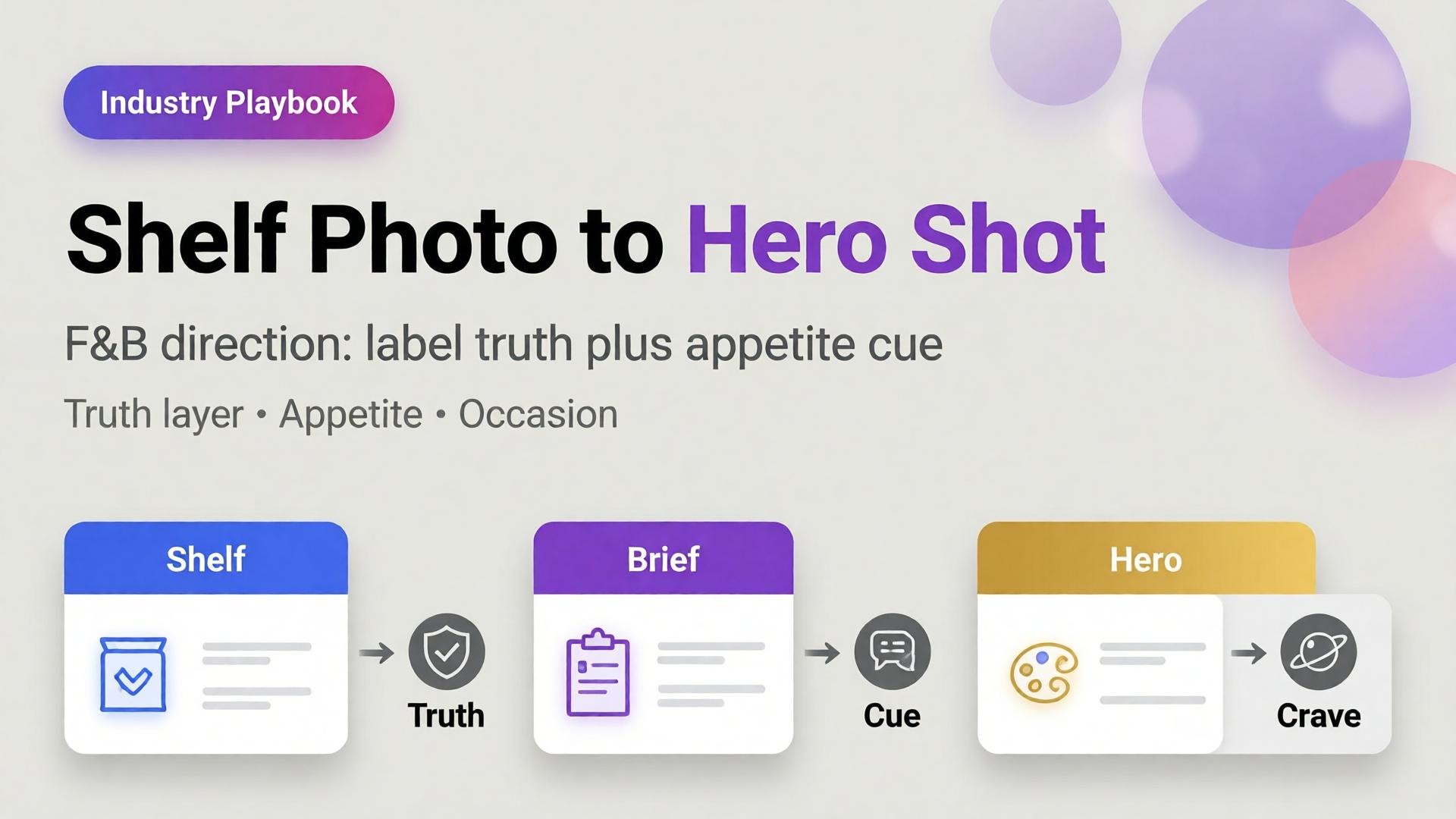
The photo starts on a phone, under fluorescent aisle light, next to three competing labels. By Friday someone asks for a “hero shot” for the PDP and a lifestyle scene for ads. The team pastes the shelf photo into an AI tool and prompts make it professional food photography. What comes back looks expensive — and wrong. Condensation in the wrong place. A label that almost matches. Steam that belongs to another dish.
AI food product photography does not fail because shelf photos are low quality. It fails because teams skip creative direction: what job the hero must do, which appetite cues are non-negotiable, and which truths the label must keep.
Key Takeaways
>
– Shelf photos are reference truth, not final creative. Treat them as geometry + label fidelity inputs.
– Products with high-quality photos convert dramatically better than weak imagery — Salsify analysis cited across 2026 roundups puts the lift near 94% versus low-quality photos (Lumepixa / Salsify, 2026).
– Listings with 5+ images show about 50% higher conversion than thinner galleries in large listing studies (Catchlab, via 2026 image stats roundups).
– F&B heroes need a dual layer: compliance/clarity + appetite scene. White-only catalogs leave money on the table; fantasy-only heroes break trust.
This is the F&B sibling of Lifestyle Context Mapping for Beauty. Parent frame: AI Ecommerce Design Is Not AI Image. Packshot discipline: Packshot Thinking.
Why Do Shelf Photos Fail as Heroes?
A shelf photo answers one question: what is on the shelf?
A hero shot answers another: why should I crave this now?
| Shelf photo job | Hero shot job |
|---|---|
| Identify SKU | Create appetite |
| Show real packaging | Stage desire + truth |
| Survive fluorescent light | Sell a moment |
| Capture available angles | Own the PDP first impression |
AI that “beautifies” without a brief usually invents a third job: look like stock food. That third job converts poorly because it belongs to no brand and no meal occasion.
In F&B, the hero is not a prettier packshot. It is a negotiated truth: label fidelity plus appetite fiction that the product can still keep.
What Creative Direction Does F&B Need Before AI?
Borrow SCENE, then specialize:
| SCENE part | F&B translation | Example |
|---|---|---|
| Story | Meal occasion | Weeknight reset, weekend brunch, post-gym |
| Context | Surface + vessel | Ceramic bowl, iced glass, picnic board |
| Emotion | Appetite cue | Crunch, melt, chill, steam, pour |
| Narrative | PDP role | Hero, ingredient proof, serve suggestion |
| Extension | Channel crop | 1:1 feed, 9:16 Story, wide banner |
Write this before generation. The shelf photo becomes the SKU reference. The SCENE brief becomes the world.
The Dual-Layer F&B Gallery
F&B teams that win online run two layers — same logic as visual commerce 2026:
Layer A — Truth / compliance
- Front label readable
- Color true to SKU
- Cap, seal, and fill level honest
- Marketplace-safe background when required
Layer B — Appetite / conversion
- Condensation, pour, steam, crumb, melt — only if true to product physics
- Hand or utensil for scale
- Plating that matches the real serve
- Light that matches the occasion (morning juice ≠ late-night chocolate)
Lifestyle additions commonly lift conversion in the 15–30% range over packshot-only layouts in industry A/B aggregates (2025–2026 ecommerce photography roundups). F&B is especially sensitive because appetite is emotional and returns are visual — items that “look different in person” remain a top return driver across categories.
From Phone Shelf Photo to Hero: A 7-Step Playbook
1. Shoot for reference, not Instagram
Straight-on label. Avoid heavy tilt. Include one 3/4 if the package has depth. Capture the barcode side only if needed for ops — not for the hero.
2. Write the non-negotiable label truths
Logo lockup, flavor name, regulatory marks, claim badges. If AI rewrites a word, the asset is dead for marketplaces.
3. Choose one appetite cue
Not five. Pick pour, steam, bite, condensation, or plating. Multiple cues usually look like a food-magazine collage.
4. Lock light logic
Cold drinks: cooler key, specular highlights. Bakery: warmer key, soft shadow. Spicy / savory: deeper contrast. Changing light mid-batch is how catalogs look like three restaurants.
5. Generate heroes from reference + brief
Use the shelf photo as product lock. Use the SCENE brief as world lock. If the model invents a new label, reject — do not “fix in Photoshop later” as a habit.
6. Build the five-image minimum
Catchlab-style listing research consistently favors richer galleries. A practical F&B set:
- Clarity hero (truth)
- Appetite hero (desire)
- Serve / pour moment
- Ingredient or texture macro
- Lifestyle or table context
7. Channel-adapt before you regenerate
Crop the approved hero into Story and banner jobs. Regeneration is for new angles — not new identities of the same bottle. Same mindset as phone-to-campaign workflow.
What Must Never Drift in AI Food Imagery?
| Element | Why it matters | Fail signal |
|---|---|---|
| Label typography | Legal + brand | Misspellings, melted letters |
| Package geometry | Recognition | Warped bottle / can proportions |
| Fill level / contents | Trust | Soup that looks empty; chips that look inflated |
| Allergen / claim badges | Compliance | Missing or invented marks |
| Food physics | Appetite credibility | Steam on iced drinks; melt on shelf-stable |
Studio food photography still costs hundreds per SKU once styling and retouching enter the quote; AI compresses unit cost when direction is clear — industry writeups in 2026 routinely cite 60–80% cost reductions versus traditional shoots for catalog-scale work. Cost only helps if rejected assets stay rejected.
Occasion Mapping for F&B (Beauty’s Sister Grid)
Beauty maps rituals. F&B maps occasions:
| Occasion | Hero cue | Avoid |
|---|---|---|
| Breakfast | Soft daylight, simple plate | Nightlife bokeh |
| Desk lunch | Compact, clean, portable | Banquet excess |
| Dinner share | Family board, steam | Clinical white only |
| Gym / recovery | Condensation, citrus, motion | Heavy garnish clutter |
| Gift / premium | Material, ribbon, quiet luxury | Street-food grit |
Map 4–6 occasions for the brand, not per SKU. Then swap the product reference through the same worlds — batch thinking for catalogs that keep growing.
When Should You Still Book a Real Food Shoot?
AI direction wins for:
- Catalog scale and seasonal flavor swaps
- Channel crops and ad variants
- Background / lifestyle exploration after label lock
Real shoots still win for:
- Flagship hero campaigns where texture is the product (artisanal crumb, fresh seafood sheen)
- Regulatory edge cases and packaging redesign launches
- Hero SKUs where returns risk is extreme if appetite oversells
Hybrid is the default mature strategy — not ideology.
Soft CTA
Turn shelf references into directed packshots and heroes inside one workflow: Orauria Packshot · Studio Guide
Frequently Asked Questions
Can AI turn a phone shelf photo into a marketplace-ready hero?
Yes — if label truth is locked and the brief defines the hero job. Without those, AI produces pretty stock that fails compliance or trust.
How many images should an F&B PDP show?
Aim for at least five: clarity, appetite, serve, texture, context. Richer galleries correlate with stronger conversion in large listing studies.
What is the biggest AI mistake in food photography?
Inventing appetite cues the product cannot keep — fake steam, impossible melt, or garnishes that imply a different recipe.
Should every F&B SKU get a lifestyle scene?
Every hero SKU should. Long-tail SKUs can inherit occasion templates with swapped references once the brand kit is locked.
How is F&B different from beauty context mapping?
Beauty maps daily rituals on the same face/body. F&B maps meal occasions and food physics. Both need a grid before generation; the rows differ.
Do I need white-background shots for food marketplaces?
Often yes for the main image. Treat white as Layer A. Appetite scenes belong in secondary slots and ads — not as a replacement for truth.
Conclusion
Shelf photos are not the enemy. Undirected AI is.
Write the occasion. Lock the label. Pick one appetite cue. Build dual-layer galleries. Adapt approved heroes before you regenerate. Reject physics lies even when they look delicious.
AI food product photography becomes a growth system when creative direction arrives before the model — not after the disappointment.
References
- Lumepixa, AI Product Photography Statistics 2026 (citing Salsify / Business Dasher; Catchlab listing study). https://lumepixa.app/blog/ai-product-photography-statistics
- Lumepixa, Product Image Statistics 2026. https://lumepixa.app/blog/ecommerce-product-image-statistics
- Adobe, 2026 Creators’ Toolkit Report, June 16, 2026. https://news.adobe.com/news/2026/06/creators-toolkit-report-2026