Most creator burnout with AI is not about tools. It is about starting from zero every post.
New hook. New face almost. New lighting world. New caption energy. The algorithm may reward the spike. The audience cannot form a memory. You become a content lottery — occasionally brilliant, never cumulative.
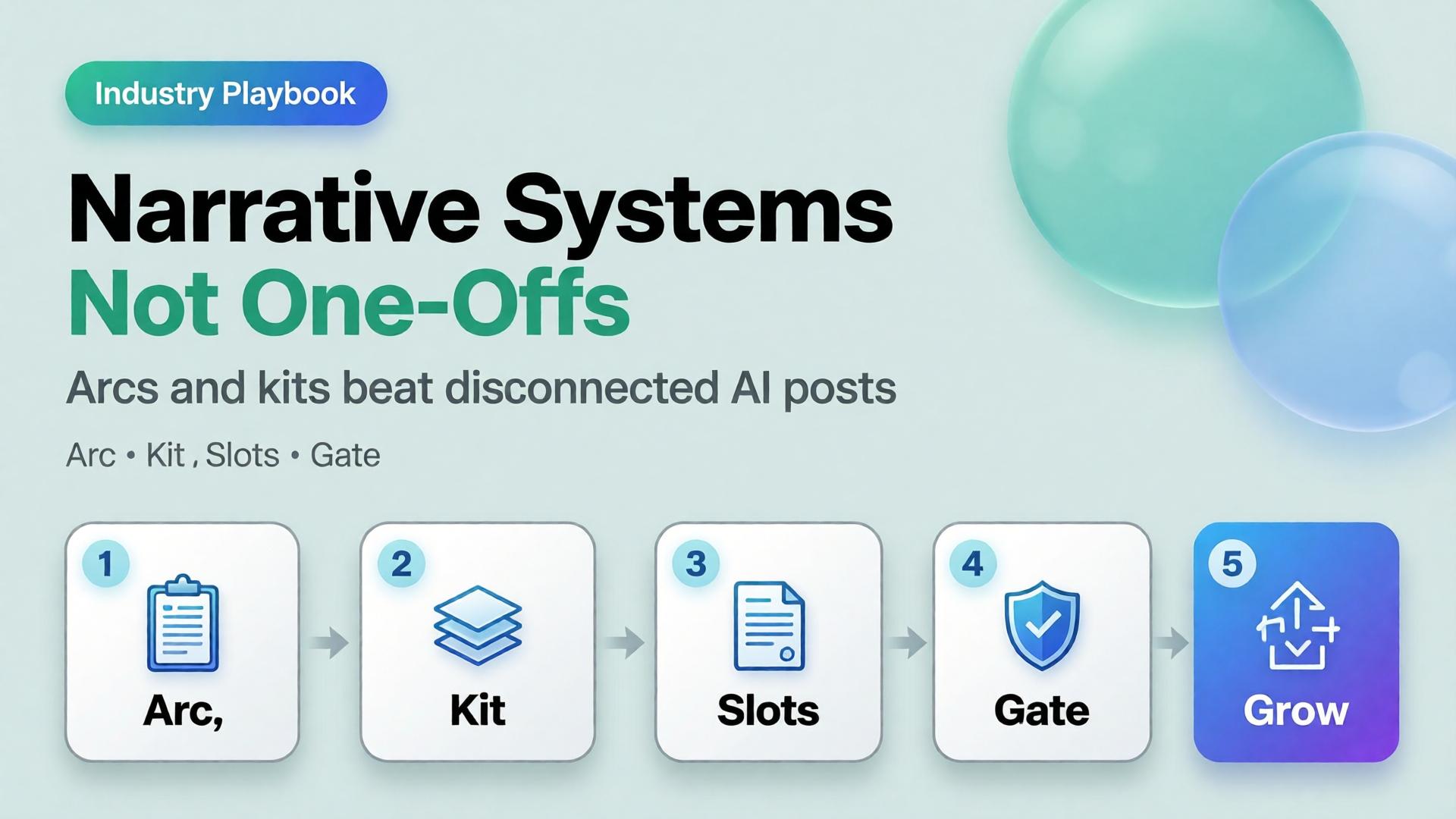
An AI content creator workflow that scales is a narrative system: a small set of arcs, a locked character/world kit, format slots that repeat, and weekly gates that protect coherence. One-off posts are expenses. Narrative systems are assets.
Key Takeaways
>
– Buffer’s 26-week study of 100K+ users found creators who posted in 20+ weeks saw about 450% more engagement per post than those who posted in four weeks or fewer (Buffer, 2025–2026).
– Consistency compounds more than heroic volume. Moving from sporadic to a steady weekly rhythm is the steepest gain curve.
– A narrative system has four parts: arc, character/world kit, format slots, curator gate.
– AI accelerates production inside the system. Without the system, AI accelerates sameness and drift.
This playbook sits with Face Consistency Is Character Design and The 3-Line Brief. Freelancers serving multiple brands can map the same spine across clients — see One Workflow Template for Five Clients.
Why Do One-Off AI Posts Feel Busy but Flat?
Because each upload asks the audience to re-learn who you are.
| One-off habit | Narrative system habit |
|---|---|
| New world every post | Recurring worlds |
| New face energy | Locked character kit |
| Hook without sequel | Arcs with episodes |
| Random formats | Slot map |
| Publish then forget | Weekly set review |
Buffer’s consistency research is blunt: showing up across weeks beats rare spikes. Creators who posted consistently for 5–19 weeks still earned about 3.4× more engagement per post than the least consistent group. AI does not change that math. It only makes it easier to produce volume that still fails to compound.
Algorithms distribute posts. Audiences distribute memory. Narrative systems optimize for memory; one-offs optimize for the next upload anxiety.
What Is a Narrative System for Creators?
A narrative system is a reusable production architecture:
- Arc — the story season (4–8 weeks)
- Kit — character, palette, light, product rules
- Slots — repeating format jobs (feed, Story, Reel, banner…)
- Gate — who can reject “pretty but off-brand”
It is SCENE at calendar scale. Each episode gets a brief. The season gets a bible.
Build the Arc Before the Prompt
Pick one season thesis (one sentence)
Examples:
- 30 days of desk-lunch upgrades for busy founders
- One outfit, eight lives — wardrobe as world-building
- From shelf photo to craving — F&B education for DTC buyers
If you cannot say the thesis without commas, you have three arcs pretending to be one.
Define episode types (not topics)
| Episode type | Job | Cadence |
|---|---|---|
| Hook | New viewer entry | 1–2× / week |
| Proof | Trust / demo | 1× / week |
| Depth | Save / share | 1× / week |
| Soft CTA | Convert | 1× / week |
| Community | Reply / stitch fuel | ongoing |
Topics rotate inside types. Types stay stable. That is how an AI content creator workflow stays recognizable when tools change.
The Kit: What Must Repeat So Stories Can Change
Without a kit, every episode renegotiates identity — the brand consistency trap in creator form.
Minimum kit:
- Character anchors (if a face appears) — see face consistency playbook
- Palette + light logic
- Three recurring locations / sets
- Product handling rules
- Caption voice (sentence length, POV, CTA style)
Adobe’s 2026 Creators’ Toolkit Report found 57% of creators still edit AI outputs moderately or extensively before publish. Editing inside a kit is craft. Editing without a kit is damage control.
Format Slots: Produce Once, Ship Many
Do not invent a new production for every ratio. Assign jobs:
| Slot | Ratio | Narrative job |
|---|---|---|
| Feed | 1:1 or 4:5 | Episode poster |
| Story | 9:16 | Behind-the-arc / poll |
| Reel | 9:16 | Motion beat of the episode |
| Carousel | multi | Proof sequence |
| Banner / email | wide | Season reminder |
| Marketplace / store | compliance + brand | Always-on identity |
This is the creator version of marketplace banner thinking — one master, many jobs — not twelve unrelated renders.
Weekly Operating Rhythm
A sustainable default for most creators in 2026 is not “post until collapse.” Buffer and industry frequency guides cluster meaningful gains around steady weekly presence, with many teams landing near 3–5 posts/week as a quality-safe band depending on platform.
Example week inside a narrative system
| Day | System action | Output |
|---|---|---|
| Mon | Arc check + 3-line briefs | 4 episode briefs |
| Tue | Generate masters in one kit | 6–10 frames |
| Wed | Adapt slots (crop/extend) | Feed + Story + Reel covers |
| Thu | Curator gate | Kill drift / keep winners |
| Fri | Publish + reply block | Posts + community |
| Sun | Set review + archive | Update kit with winners |
Notice what is missing: “open AI and hope.” Hope is not a workflow stage.
How AI Fits Without Taking Over the Story
Use AI for:
- Variant volume inside a locked kit
- Format adaptation
- Background / set exploration before lock
- First drafts of captions you will voice-edit
Do not use AI for:
- Replacing the season thesis
- Recasting your face every episode
- Inventing a new brand world mid-arc
- Publishing without a set review
Model choice comes after direction — same rule as choose the image model after creative direction.
Soft CTA
Design narrative systems as workflows, not vibes: Orauria Workflow · Gallery
Frequently Asked Questions
What is an AI content creator workflow?
It is a repeatable system for planning, generating, adapting, and publishing creator content with AI — built around arcs and kits, not isolated prompts.
How is a narrative system different from a content calendar?
A calendar schedules dates. A narrative system defines what must stay the same so scheduled posts accumulate meaning. You need both; calendar without system is a to-do list.
How long should a creator arc run?
Four to eight weeks is a practical season. Shorter arcs rarely compound. Longer arcs need mid-season kit reviews to prevent drift.
Do I need to post every day?
No. Buffer’s data emphasizes consistent weeks over extreme daily volume. A sustainable rhythm you can keep beats a heroic week you abandon.
Can freelancers use narrative systems for clients?
Yes — keep the system spine fixed and swap kits per client. That is the core of multi-client workflow templates.
What kills narrative systems fastest?
Publishing exceptions without updating the bible — “just this one off-brand Reel.” Exceptions become the new default in two weeks.
Conclusion
One-off AI posts spend attention. Narrative systems invest it.
Write a season thesis. Lock a kit. Define episode types. Fill format slots from masters. Gate the week as a set. Let AI multiply inside the rules — not rewrite the rules nightly.
The creators who win with AI in 2026 will not be the ones who generate the most. They will be the ones whose audience can finish the sentence: this is another chapter of…
References
- Buffer, Buffer Data — consistency study (100K+ users, 26 weeks). https://buffer.com/resources/buffer-data/
- Buffer, How to Grow on Social Media in 2026. https://buffer.com/resources/creator-growth-playbook/
- Buffer, How Often to Post on Social Media in 2026. https://buffer.com/resources/social-media-frequency-guide/
- Adobe, 2026 Creators’ Toolkit Report, June 16, 2026. https://news.adobe.com/news/2026/06/creators-toolkit-report-2026